Climate Emotions

Government opinion tracker shows levels of climate concern remain high in 2023

21 September 2023

Government climate opinion tracker data shows that concern about climate change remains very high in the UK in 2023:

  • The majority of people (81%) said they were at least fairly concerned about climate change in summer 2023, with no significant change in overall levels of concern since Winter 2022 and Spring 2023 (82%). In Summer 2023, 40% said they were very concerned and 4% said they were not at all concerned.
  • There has been a slow but steady decline in overall concern since Autumn 2021, and a steady increase in the proportion of people saying they were not very or not at all concerned – but the overall trend is continuing high concern.

There were also some important differences between segments of the population:

  •  Concern about climate change was higher for women (85%, compared with 78% of men)
  • Concern was higher for people educated to degree level (88%, compared with 82% of those with other qualifications and 70% of people with no qualifications).
  • The proportion of those ‘very concerned’ about climate change was higher among those aged over 65 (46%) and lower among those aged 16 to 24 (34%) and those aged 35 to 44 (33%).

Tags:

The latest from the Climate Emotions timeline:

Opinion Insight 20th September 2026

Tracker data: Support for local renewables still higher than we think it is

The Climate Barometer Tracker has followed public and MP support for local renewable infrastructure in their area since 2022. Since the beginning, we have pointed to a perception gap between the (high) public support for local renewables projects such as new solar parks and wind farms, and what the public and MPs think support and opposition looks like.

The latest wave of the tracker shows that this gap remains: public support for new local renewable projects remains high. People, and their representatives continue to underestimate this support, and overestimate opposition.

In this wave, we also asked those who have personal experience with local infrastructure projects, how they felt about them. Overall, those who have a newly proposed project in their area, and those who have a fully or partially built one, feel accepting, proud, and relieved. A minority report feeling worry, anger, and upsetness, but for the most part, emotional responses are positive.

Those experiencing the most negative emotions were people living in areas where a renewable energy project had been rejected.

Opinion Insight 13th July 2026

Hot and bothered: Britons blame climate change for June 2026 heatwave

New polling by More in Common shows that 86% of the UK public believe climate change to be either entirely or partially responsible for the June 2026 heatwave. This holds true even for those opposing net zero, with 63% of them seeing climate change as at least in part to blame for the extreme heat.

At the same time, more than 4 in 5 think the UK is unprepared to cope with extremely hot weather (84%) and more than 3 in 4 see the country as ill-equipped to deal with water shortages and drought (77%).

Asked about which groups they think are most negatively affected by extreme heat, the elderly (88%) and children (68%) were seen as worst impacted, closely followed by “ordinary people” (66%).

Describing the most recent heatwave in their own words, responses revealed a public struggling to cope, with words like “hot”, “worried”, “unbearable” and “uncomfortable” being mentioned most often:

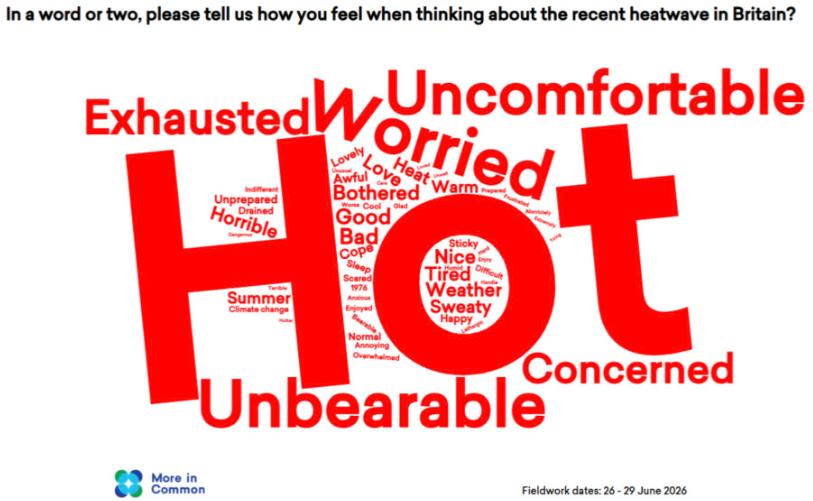
Relatedly, the majority expect more political leadership on the issue: 59% of the public say they want the government to help people like them cope with the impacts of extreme heat, compared to 26% who think the government should do the same amount and only 5% who say the government should do less to help people like them cope.

  • Source: More In Common
  • Author: More In Common
  • Date: 13th July 2026
View Climate Emotions timeline now

Add Feedback