Climate Emotions

Large scale survey of young people across 10 countries shows majority are worried and feel the future is frightening

01 December 2021

In a survey of 10,000 children and young people (aged 16–25 years) across ten countries around the world (including the UK) found that:

  • Children and young people in all countries were worried about climate change (59% were very or extremely worried and 84% were at least moderately worried).
  • More than 50% reported each of the feeling the following emotions in relation to climate change: sad, anxious, angry, powerless, helpless, and guilty.
  • More than 45% of respondents said their feelings about climate change negatively affected their daily life and functioning.
  • Many reported a high number of negative thoughts about climate change (75% said that they think the future is frightening and 83% said that they think people have failed to take care of the planet).
  • Respondents rated governmental responses to climate change negatively and reported greater feelings of betrayal than of reassurance.

Tags:

The latest from the Climate Emotions timeline:

Opinion Insight 13th July 2026

Britons blame climate change for June 2026 heatwave

New polling by More in Common shows that 86% of the UK public believe climate change to be either entirely or partially responsible for the June 2026 heatwave. This holds true even for those opposing net zero, with 63% of them seeing climate change as at least in part to blame for the extreme heat.

At the same time, more than 4 in 5 think the UK is unprepared to cope with extremely hot weather (84%) and more than 3 in 4 see the country as ill-equipped to deal with water shortages and drought (77%).

Asked about which groups they think are most negatively affected by extreme heat, the elderly (88%) and children (68%) were seen as worst impacted, closely followed by “ordinary people” (66%).

Describing the most recent heatwave in their own words, responses revealed a public struggling to cope, with words like “hot”, “worried”, “unbearable” and “uncomfortable” being mentioned most often:

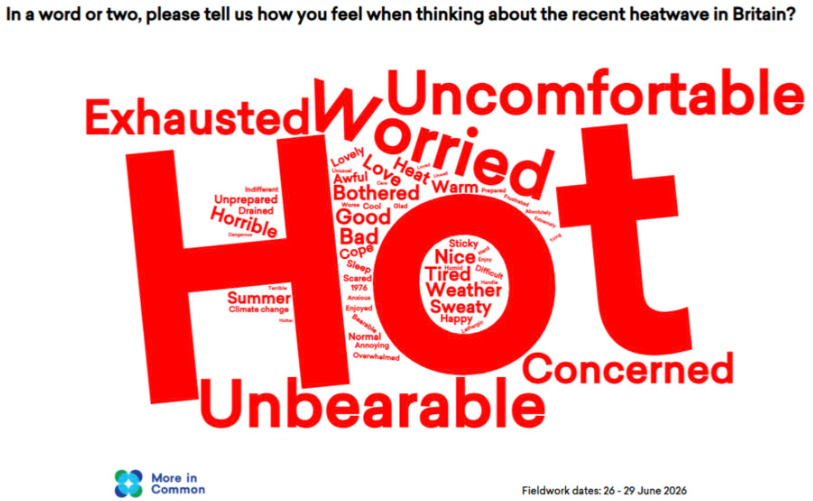
Relatedly, the majority expect more political leadership on the issue: 59% of the public say they want the government to help people like them cope with the impacts of extreme heat, compared to 26% who think the government should do the same amount and only 5% who say the government should do less to help people like them cope.

  • Source: More In Common
  • Author: More In Common
  • Date: 13th July 2026
Opinion Insight 13th November 2025

Division is growing – which makes communication on climate change more difficult

Climate change didn’t cause the culture wars, but culture wars are making climate change harder to solve.

In new research from Kings College London (KCL), divisions over climate change are seen as worse than divisions over Brexit, with the public more likely to say there is tension between climate change sceptics and believers (64%) than between Leavers and Remainers (52%), or between younger and older generations (45%).

This is despite the broad-based consensus on the importance of the issue that Climate Barometer data evidences, and which is seen consistently in wider research (e.g. the recent Britain Talks Climate & Nature report, which highlights widespread care for nature, wildlife and the benefits that the transition to clean, renewable energy can bring).

More new research (from Hope Not Hate) diving into the differences between people who intend to vote Reform highlights climate change as one of the dividing lines among a disjointed coalition of factions. ‘Squeezed Stewards’ (in an echo of More in Common’s ‘Rooted Patriots’ segment, who have high levels of threat perception around environmental risks) care about nature and acknowledge the climate crisis. But the ‘Hardline Conservatives’ subgroup of Reform backers are much more likely to be in the minority of people who reject action on climate change entirely.

View Climate Emotions timeline now

Add Feedback