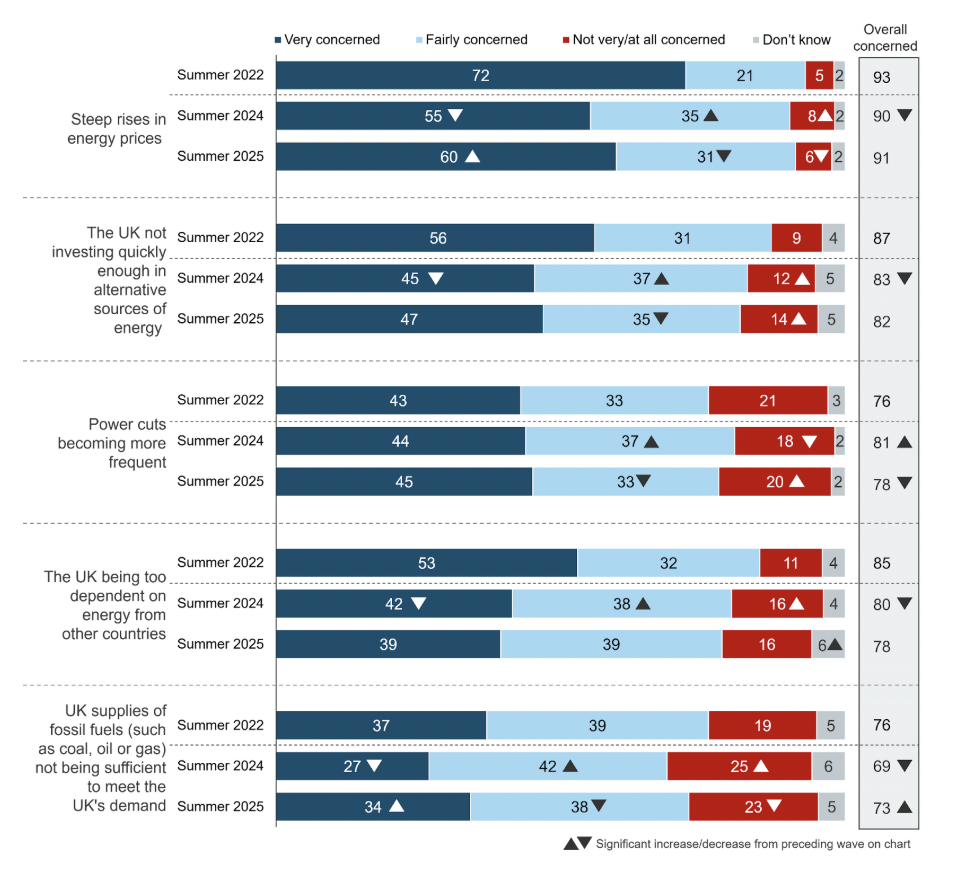
Even when the question becomes more specific – about drilling in the North Sea rather than fossil fuels in general – we see a similar pattern: overall people disagree with proposals to prioritise drilling in the North Sea over investing in renewables. This view is grounded in the economic reality of how much North Sea oil and gas is in fact (in an affordable way) recoverable.
But there are clear differences according to voting intention, and the slight uptick in support for fossil fuels as a way of boosting energy security is largely due to Reform (and to a lesser extent Conservative) supporters’ more pro-drilling stance. EU data shows that for right-wing voters, imported oil and gas tends to be seen as a more straightforward solution to energy insecurity than renewables.
There is an important lesson here: whilst many people instinctively associate renewables with energy security, the argument (whether grounded in fact or not) that domestic oil and gas can help deliver more secure, affordable energy is still something that a significant chunk of the voting public buy into.
So is ‘energy security’ a good way of framing messages about climate change?
Energy security as a message frame
Given ‘energy security’ doesn’t mean the same thing to everyone, and political groups on the right tend to connect it to oil and gas, this is an important question to get right.
Climate Barometer/Public First message testing research carried out last year (with input from several climate/energy groups), found that energy security was the most persuasive of six major arguments that join the dots between net zero and the compelling reasons for action.
The energy security message, which spoke about “spiralling costs when the next global crisis hits”, resonated across the political spectrum, with 78% supporting it overall.
This aligns with other national data which shows that 76% of people in the UK agree “we should invest in clean energy nationally, like wind, solar, nuclear and other clean energy sources [to protect the country] from global price shocks and geopolitical risks”.
Even at the local level where debates can be more contextualised, energy security stands out as a top “pressing reason to act”. In panel-based research led by Local Storytelling Exchange and Sustainability First, residents from the East Coast of the UK strongly agreed that “the UK’s energy security situation is vulnerable and so we must generate more renewable energy”. Labour’s goal of becoming a ‘Clean Energy Superpower’ has long rested on similar framing.
With that in mind, is energy security a winning frame for climate communicators?
There is some evidence in the opposite direction: in a 2022 IPPR report, messages that talked about energy security as a ‘transactional’ benefit of climate solutions did not perform as well as messages which focused more on the moral case for climate action (e.g. protecting future generations). The authors argued: “These narratives often generate high levels of agreement among ordinary voters, but do not appear to be emotionally persuasive enough to change their underlying beliefs or priorities.”
But the global, national and local energy context has shifted substantially since 2022.
And during periods of enhanced risk and jeopardy – such as (another) military conflict with severe and tangible economic consequences for ordinary people – energy security takes on much greater emotional weight.
This enhanced emotional weight – at a moment like this – is likely to change the equation on energy security.
And like any other climate narrative, if it is linked to tangible aspects of people’s lives, and shows (through practical, relatable examples) how community-focused climate policies (like the Local Power Plan) can help protect people’s homes and businesses from shocks, then the idea of energy security stops being an abstract ‘co-benefit’ of action on climate change, and becomes grounded in lived experience.