Energy Independence & Energy Security

Energy security: opinion insights and message testing

26 March 2026

The regional conflict triggered by the US’ attacks on Iran have already led to thousands of military and civilian casualties.

With the closure of the Strait of Hormuz (through which around a fifth of global oil supplies are carried) and attacks on fossil fuel production facilities, oil and gas prices have surged. Disruption to global supplies and prices are expected for many years. The Chief of the International Energy Agency, Faith Birol, said the world faces the “greatest global energy security challenge in history”.

As countries continue to grapple with how to respond, we ask: What do people understand by the term ‘energy security’, and what does this tell us about communicating with public audiences on renewables, energy bills and the UK’s own small piece of the oil and gas industry in the North Sea?

Energy security in the public mind

Over the last decade, energy security has shifted from an “unfamiliar” and “emerging” public concern, to something at the forefront of energy debates, and written into ministerial titles and government departments.

Research has long shown that ‘energy security’ is understood in a wide range of different ways: whereas governments might view energy as a strategic resource, it is more likely to be viewed as a basic need or a ‘right’ by voters.

People generally understand energy security through personal, tangible experiences related to cost, reliability, and emotional feelings of vulnerability (rather than as a geopolitical concept).

But that doesn’t mean that day-to-day, security of energy supply is generally top of mind.

Project Tempo’s latest Europulse survey (in 2025) found that in the UK, less than 15% of people picked ‘energy security’ as one of their top five concerns. ‘Climate change’ placed 13th and ‘energy bills’ at 10th, with the cost-of-living crisis standing out as the top concern.

As the Europulse team puts it “voters do care about energy security, but they don’t respond to the phrase itself. What they are really asking is: will the lights stay on, will my bills come down, and where blackouts have happened, are we sure they won’t happen again? Energy security resonates, but only if it’s connected to everyday experiences.”

Renewables vs fossil fuels: what does more for energy security?

For the most part, people in the UK are less worried about the risks to energy security posed by renewables (around 35%) than they are by fossil fuels (around 45%). And when asked directly whether investing in clean energy is a way to increase energy security and be ‘protected from global price shocks and geopolitical risks’, more than 75% agree that it is.

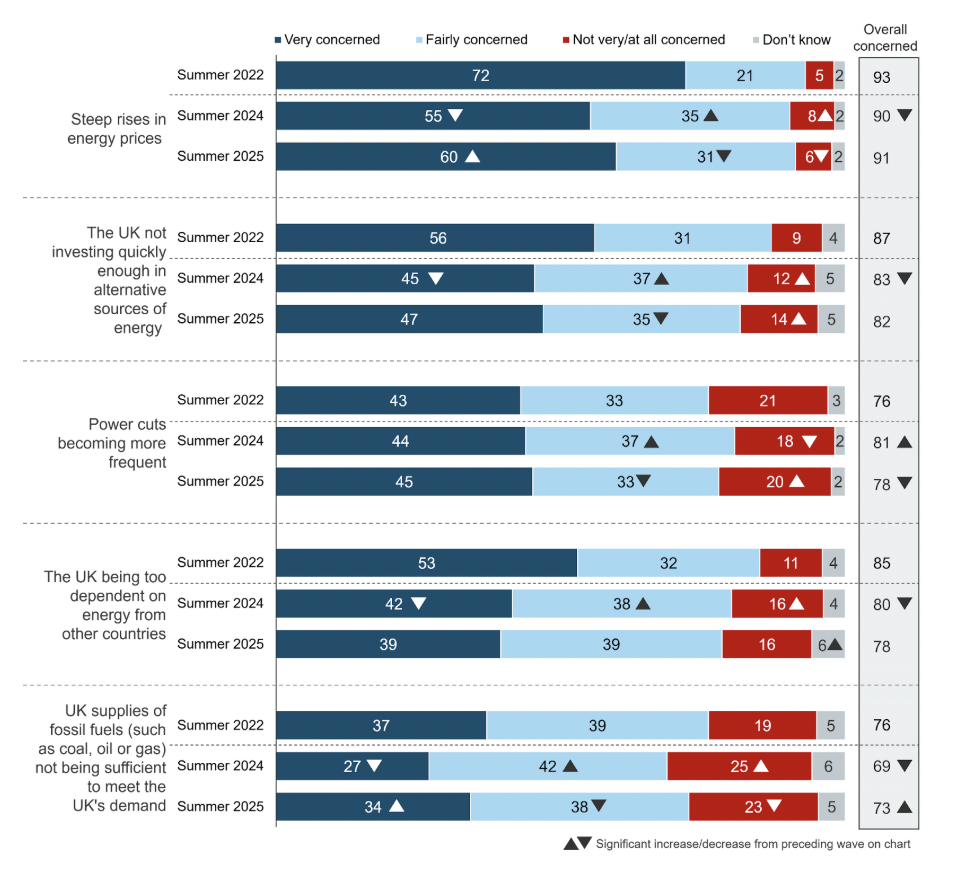
The latest DESNZ attitude tracker (summer 2025) tells a similar story: people think that the UK not being faster to invest in ‘alternative’ (i.e. non-fossil fuel) sources of energy is more of a security risk than our own supplies of fossil fuels running out.

And our own data at Climate Barometer backs this up.

When we ask people what they think is the best way to ensure the UK’s energy security, clear majorities both among the public (55%) and MPs (68%) select expanding renewables and reducing the use of fossil fuels.

However, the percentage of the public and MPs who think that increasing our supply of oil and gas in the UK is the better way of ensuring the UK’s energy security has slowly crept up (from 18% to 24%).

Even when the question becomes more specific – about drilling in the North Sea rather than fossil fuels in general – we see a similar pattern: overall people disagree with proposals to prioritise drilling in the North Sea over investing in renewables. This view is grounded in the economic reality of how much North Sea oil and gas is in fact (in an affordable way) recoverable.

But there are clear differences according to voting intention, and the slight uptick in support for fossil fuels as a way of boosting energy security is largely due to Reform (and to a lesser extent Conservative) supporters’ more pro-drilling stance. EU data shows that for right-wing voters, imported oil and gas tends to be seen as a more straightforward solution to energy insecurity than renewables.

There is an important lesson here: whilst many people instinctively associate renewables with energy security, the argument (whether grounded in fact or not) that domestic oil and gas can help deliver more secure, affordable energy is still something that a significant chunk of the voting public buy into.

So is ‘energy security’ a good way of framing messages about climate change?

Energy security as a message frame

Given ‘energy security’ doesn’t mean the same thing to everyone, and political groups on the right tend to connect it to oil and gas, this is an important question to get right.

Climate Barometer/Public First message testing research carried out last year (with input from several climate/energy groups), found that energy security was the most persuasive of six major arguments that join the dots between net zero and the compelling reasons for action.

The energy security message, which spoke about “spiralling costs when the next global crisis hits”, resonated across the political spectrum, with 78% supporting it overall.

This aligns with other national data which shows that 76% of people in the UK agree “we should invest in clean energy nationally, like wind, solar, nuclear and other clean energy sources [to protect the country] from global price shocks and geopolitical risks”.

Even at the local level where debates can be more contextualised, energy security stands out as a top “pressing reason to act”. In panel-based research led by Local Storytelling Exchange and Sustainability First, residents from the East Coast of the UK strongly agreed that “the UK’s energy security situation is vulnerable and so we must generate more renewable energy”. Labour’s goal of becoming a ‘Clean Energy Superpower’ has long rested on similar framing.

With that in mind, is energy security a winning frame for climate communicators?

There is some evidence in the opposite direction: in a 2022 IPPR report, messages that talked about energy security as a ‘transactional’ benefit of climate solutions did not perform as well as messages which focused more on the moral case for climate action (e.g. protecting future generations). The authors argued: “These narratives often generate high levels of agreement among ordinary voters, but do not appear to be emotionally persuasive enough to change their underlying beliefs or priorities.”

But the global, national and local energy context has shifted substantially since 2022.

And during periods of enhanced risk and jeopardy – such as (another) military conflict with severe and tangible economic consequences for ordinary people – energy security takes on much greater emotional weight.

This enhanced emotional weight – at a moment like this – is likely to change the equation on energy security.

And like any other climate narrative, if it is linked to tangible aspects of people’s lives, and shows (through practical, relatable examples) how community-focused climate policies (like the Local Power Plan) can help protect people’s homes and businesses from shocks, then the idea of energy security stops being an abstract ‘co-benefit’ of action on climate change, and becomes grounded in lived experience.

The latest from the Energy Independence & Energy Security timeline:

Opinion Insight 5th February 2026

Clean energy is a winner across the political spectrum – but support for fossil fuels is slowly creeping upwards again

Like support for the 2050 net zero target, support for renewables comfortably outpaces opposition. And people are much more likely to consider renewables as the route to building energy security than fossil fuels.

But there is a creeping growth in support for oil and gas – wrapped up in the very same conversation about energy security. Since the 2024 election, support among MPs for expanding drilling for oil and gas has inched up, driven by Conservative MPs pursuing an increasingly Reform-influenced agenda on domestic energy policy.  


Yet, despite most Britons supporting clean energy, even when it means wind and solar farms in their local area, there remains a clear perception gap. As covered by Business Green, our most recent data shows that both the public and MPs continue to overestimate local opposition to these renewable developments. 

Policy Insight 28th September 2023

Labour Party confirms plans for GB Energy ahead of 2023 conference

The Labour Party has pledged to create Great British Energy, a new, publicly-owned clean energy company to make the UK ‘energy independent’ and deliver 100% clean energy by 2030.

  • Source: The Labour Party
  • Date: 28th September 2023
Opinion Insight 27th September 2023

YouGov: There is a generational divide in support for more oil and gas extraction

Polling by YouGov on behalf of Global Witness shows a lack of support for fossil fuel production, and a clear age gap in perspectives on oil and gas extraction.

  • Only 8% think increasing fossil fuel production is the best way to increase energy security.
  • Just 10% believe more oil, gas and coal is the best way to reduce energy bills.
  • 42% overall would prefer to wind down North Sea oil and gas production, compared with 33% preferring to exploit all economically viable supplies
  • Among those aged 50-64, support for oil and gas extraction was at 39%, and this was higher at 57% in the 65-plus age group.
  • Support for oil and gas extraction was much weaker among younger generations, with only 17% of 18 to 24-year-olds and 21% of 24 to 49-year-olds backing this option.

Depending on which party (Labour or the Conservatives) is in power after the 2024 election, demographic differences like this may become even more prominent: a Labour government that secured the support of younger voters might be in a position to move significantly faster in terms of the social license to phase out oil and gas drilling in the North Sea.


  • Source: The Independent
  • Author: Rebecca Speare-Cole
  • Date: 27th September 2023
View Energy Independence & Energy Security timeline now

Add Feedback