Heat, Drought & Wildfires

The Cooling Roadmap for London

01 August 2026

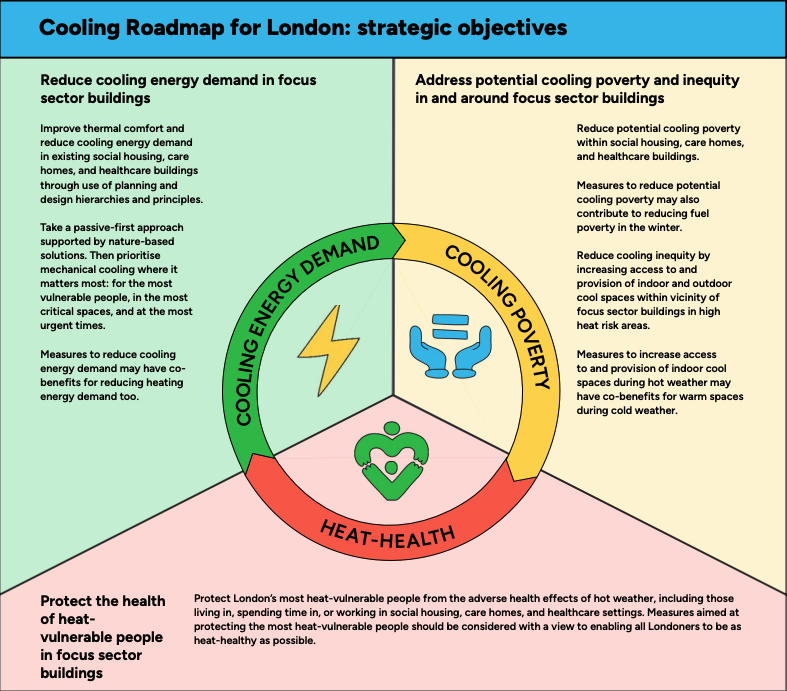
The Cooling Roadmap for London, delivered by Love Design Studio and Shade the UK, makes five strategic insights clear:

  1. The rise in cooling energy demand is a resilience risk. Without intervention, London faces rising energy demand and infrastructure pressure during extreme heat events.
  2. Cooling inequity is a social justice issue. Vulnerable residents are disproportionately impacted by heat and least able to afford active cooling.
  3. Delay increases lock-in risk. If buildings are retrofitted for winter performance only, or default to active cooling as a first response, cooling energy demand will escalate.
  4. Passive-first and nature-based action reduces long-term active cooling costs. Buildings that absorb less heat require rightsized, more cost-effective, and highly efficient active cooling systems.
  5. Cooling is cross-cutting. Solutions must be co-ordinated with retrofit policy, public health, biodiversity, energy planning, housing strategy and climate adaptation.

Commenting on the CRL, Mayor of London and Co-Chair of C40 Cities, Sadiq Khan said:

“Extreme heat due to climate change is a danger to us all, and the CRL prioritises three sectors where heat risk is most acute – social housing, social care and healthcare, testing this in London boroughs.”

“The climate crisis is not a business-as-usual situation; the urgency of extreme heat demands action now, and I am proud to say that London is positioned to become a global leader in sustainable, efficient and equitable cooling.”

Reference article:

  • Source: london.gov.uk
  • Authors: Love Design Studio, Shade the UK, C40 Cities, Greater London Authority.
  • Date: 1st August 2026

The latest from the Heat, Drought & Wildfires timeline:

Wider Context 26th August 2026

40,000 extra people died on England’s hottest days between 1988 and 2025

More than 40,000 extra people died on England’s hottest days between 1988 and 2025 compared with what would be expected in normal temperatures, according to new ONS data.

Deaths from high heat are expected to keep climbing as climate change and an ageing population combine, with older people, children and the unwell most at risk.

The strain has been visible across the health system: A&E departments saw their busiest period on record, with almost 2.5 million attendances a month in May, June and July, with record-breaking heat cited as a key factor. Nurses reported collapsing on shift amid what their union called “inhumane and impossible” conditions.

  • Source: the Guardian
  • Author: The Guardian
  • Date: 26th August 2026
View Heat, Drought & Wildfires timeline now

Add Feedback