  • Overview
  • Aug '26
    YouGov poll: Few want another heatwave, except Reform voters.
  • Public strongly back maximum workplace temperature
  • As climate impacts intensify, who should pay for the costs?
  • Poll: Extreme heat is disrupting work, exercise and sleep.
  • Driest July in nearly 200 years, Met Office says
  • How do the public engage with climate ‘adaptation’ in 2026?
  • Jul '26
    Record wildfire season hits UK and Europe
  • England on track this year for the highest number of heat-related deaths
  • Heat is making Brits more fearful of the future
  • Climate coverage hit a high in 2026 due to heatwaves
  • Child heatwave exposure in the UK already at record levels for 2026, as drownings spike
  • Stories of extreme weather and local community action across the UK
  • The Birmingham school making changes to cope with heat
  • ‘Climate’ mostly absent from national media coverage of record-breaking June heatwave
  • Britons blame climate change for June 2026 heatwave
  • Parents concerned for children’s safety during UK heatwaves
  • Poll: People’s sleep and health being impacted by extreme heat
  • Jun '26
    How a local business in Birmingham is adapting to extreme heat
  • Britons view climate preparedness as an urgent, top priority
  • May '26
    The Welsh farmers tackling wildfires
  • The public want urgent action on floods, heat, and droughts
  • CCC: British way of life is under threat from heat, flooding and drought
  • Public believe climate risks are becoming more frequent and severe
  • Apr '26
    Behavioural responses influenced by heat alert severity
  • Mar '26
    Heat resilience policies widely supported as majority continue to think UK is unprepared
  • Sep '25
    2025 is UK’s hottest summer on record
  • Jul '25
    Miliband’s ‘State of the UK’ address on climate impacts
  • To help people prepare for extreme heat, we must communicate better
  • Jan '25
    Majority think UK is not prepared for climate impacts
  • Nov '24
    Unprecedented 2022 heatwave was experienced unevenly
  • Oct '24
    Growing calls for a ‘climate resilient net zero’
  • Sep '24
    Almost half of Britons have personally experienced heat waves
  • Jul '24
    More focus needed on ethnicity and climate impacts link
  • Feb '24
    Decision makers don’t feel prepared for further heat events like the summer of 2022
  • Nov '23
    Making sense of public opinion on climate impacts
  • Oct '23
    Report: How people of colour experience climate change in Britain
  • Sep '23
    Climate Change Committee: How to help the UK public prepare for climate impacts
  • Summer 2023 was the hottest on record globally
  • Apr '23
    Tracker data: Gender divide in MPs’ beliefs about cost of climate impacts
  • Jan '23
    What shapes people’s engagement with heat risks?
  • Oct '22
    Research paper: Media portrayal of heatwaves undermines the seriousness of heat risks
  • Aug '22
    ACT Climate Labs: How to combat misinformation around extreme weather
  • Jul '22
    UK experiences temperatures above 40°C for the first time
  • Mar '20
    Cardiff University polling: concern about heat risks has increased over the past decade but floods still top the risk table
  • Nov '19
    Report: Vulnerable people don’t feel they are at risk from heat
Topic

Heat, Drought & Wildfires

Filter content Please note: The page will automatically update when any filters are changed or set.
  • The Latest

    As Europe warms twice as fast as any other continent, heat risks in the UK are intensifying at an alarming rate. More than 10,000 heat-related deaths have occurred between 2020 and 2024. The summer of 2026 – with more than five heatwaves, an unprecedented ‘firewave’, and an ‘exceptionally serious’ drought – saw close to 3,000 heat-related deaths in May and June alone.

    In this context, heat has become the most commonly reported climate impact in the UK. This topic thread highlights how it is now making Britons more fearful of the future, parents scared for their children’s safety, and is disrupting the nation’s health, sleep and work. 

    Heat risks aren’t felt equally. The data increasingly reveals how heat, drought and fires are experienced differently due to politics, region, income and ethnicity. And at the local level people are facing up to heat, drought and fires in different ways: from Welsh farmers embracing nature-friendly approaches, to Birmingham schools and restaurants adapting to the heat.

    But despite community actions, the nation has repeatedly warned that we are not prepared. This widespread sentiment underpins why people want climate risks to be taken much more seriously – with urgent action to build resilience seen as a ‘top priority’.

    In practice, this translates into support for maximum working temperatures, more greenspace, better regulations, and solid plans put in place for when heat, drought and fires hit. With the affordability of many measures remaining front and centre – rather than the burden falling to those worst affected, the public will be looking to the government and the worst polluters to step up.

    This thread was developed with input from the Centre for Climate Change and Social Transformations (CAST), Local Storytelling Exchange, and Climate Outreach.

  • Opinion Insight 19th August 2026

    YouGov poll: Few want another heatwave, except Reform voters.

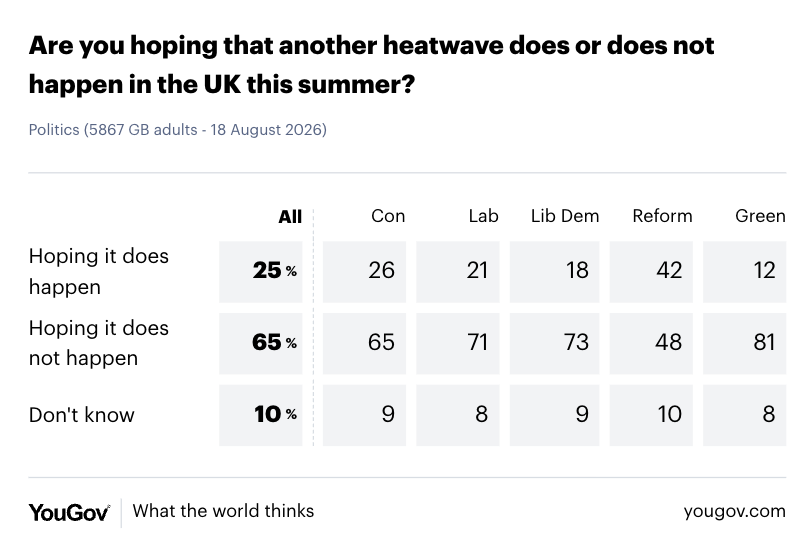
    Polling by YouGov – carried out in mid-August after the UK’s summer of five record-breaking heatwaves – shows only a quarter want to see another heatwave (25%), while two-thirds of people are not hoping it ‘does not happen’ (65%).

    The polling comes the same week Richard Tice of Reform drew criticism for telling people to “enjoy” the heat, to reap it’s benefits (such as British winemaking), while suggesting that the only way to respond to climate change is to adapt.

    This, along with the new polling, spotlights how heatwaves have become another politically divisive issue.

    While a sizeable number of Reform voters do not hope for more heat (48%), they are by far the most likely group to say they are hoping for another heatwave (42%). The rest of the political spectrum do not share this view (just 21% of Labour and 12% of Green voters agree, for instance).

    Opinion Insight 13th August 2026

    Public strongly back maximum workplace temperature

    New polling by YouGov for Friends of the Earth reveals a high level of public support for the introduction of national maximum workplace temperature limits. 79% of people backed this measure amidst a summer of heat extremes in the UK, while just 10% were opposed. 11% said they don’t know.

    The poll – carried out at the end of July following successive UK heatwaves – also found that:

    • 87% of people think the UK is not adequately prepared for extreme weather events such as heat and drought. This includes 81% of Reform and 84% of Conservative supporters. This suggests a rising sense of unpreparedness, since Climate Barometer asked this question in October 2024.
    • A majority (52%) say they’d prefer the government to tackle climate adaptation and efforts to cut carbon emissions simultaneously, compared to prioritising one or the other (reaffirming Climate Barometer findings).
    • Nearly half of respondents (49%) say they have become ‘more concerned’ for the welfare of friends and family. Just 1% said they feel ‘less concerned’ and 45% who say they feel ‘no difference’.
    Opinion Insight 7th August 2026

    Poll: Extreme heat is disrupting work, exercise and sleep.

    In new polling by Ipsos, over half of British adults (56%) report that this year’s extreme heat has disrupted their ability to carry out normal daily activities like working, exercising, or sleeping.

    And although people in the UK are trying to adapt their homes to cope with the heat – many have been finding costs to be a major barrier. Ipsos report that the top reason for not planning to make home cooling changes is “lack of affordability” (39%).

    3 in 4 (74%) said they were concerned about climate change today following heatwave summer, and concerns about future summers were also clear: 9 in 10 (87%) think it’s likely that Britain will continue to experience similar severe heatwaves into the future.

    Wider Context 3rd August 2026

    Driest July in nearly 200 years, Met Office says

    England and Wales have provisionally recorded their driest July in nearly 200 years, according to Met Office data. The dry spell has pushed most of England, and all of Wales, into drought, following four successive summer heatwaves.

    The Met Office figures also confirm that June was the hottest on record for England, driven by a searing heatwave in the final days of the month. That heatwave brought red heat alerts for three consecutive days – the first time this has happened.

    The strain of the extreme heat has also been felt within the health service. At least six NHS trusts in England have declared critical incidents because of the heatwave. Reports suggest the heat has caused problems with IT systems, cancer equipment, lab testing and scanners. Critical incidents are declared when a service comes under such extreme pressure that a hospital’s ability to deliver safe and effective care is under threat.
    • Source: the Guardian
    • Date: 3rd August 2026
    Opinion Insight 3rd August 2026

    How do the public engage with climate ‘adaptation’ in 2026?

    A new research output by Climate Outreach shows that support for adaptation action significantly increases when people are shown tangible solutions, such as heat-proofing our homes and restoring natural flood defences.

    The piece – based on a survey of 7,000 people across Britain (carried out in 2025) and in-depth focus groups across the UK – found that:

    • Three-quarters of people (75%) believe the government needs to take climate change “seriously” – this means a focus preparing for the worst impacts of climate change, for instance, by making our homes more suited for the heat, and building better flood defences.
    • Most people give equal support for actions that count as adaptation and mitigation. A majority recognises that both adapting to intensifying climate impacts and lowering our future carbon emissions are of equal importance.
    • The terms ‘climate adaptation’ and ‘climate resilience’ aren’t widely understood. Only half of people know what ‘climate adaptation’ means, whilst less than half know what ‘climate resilience’ is.
    • The way climate adaptation is framed makes a huge difference to how much people support it. The more we explain what adaptation actions are and why we are doing them, the more people support the action.

    The findings echo Climate Barometer tracker data which shows that adaptation and mitigation are supported equally, as well as past research by Climate Outreach/Cardiff University showing that the public see these broad responses as ‘two sides of the same coin’.

    • Source: Climate Outreach
    • Author: Climate Outreach
    • Date: 14th July 2026
    Wider Context 31st July 2026

    Record wildfire season hits UK and Europe

    Massive fires have been raging in central Spain and southwest France, forcing the evacuation of more than 360,000 people. Three people have died and thousands of homes have been destroyed.

    Rapid research from the World Weather Attribution initiative found that climate change made the blazes at least twice as likely in France and at least 20 times more likely in Spain. Events of this intensity, the researchers add, are now expected to occur once every 20 years in southwestern France and once every six years in central Spain.

    In the UK, hundreds of people were evacuated and a major incident declared after a wildfire spread over more than 80 hectares (200 acres) on the Suffolk coast, just a few miles from the Sizewell B nuclear power station. Firefighters have responded to 393 wildfires across England and Wales in July, making it the busiest month on record and placing significant pressure on crews and resources.

    The underlying pattern is consistent across the UK and Europe: back-to-back heatwaves encourage vegetation to grow, then dry it out, producing ideal fuel for fires.

    • Source: YouTube
    • Author: BBC News
    • Date: 28th July 2026
    Wider Context 30th July 2026

    England on track this year for the highest number of heat-related deaths

    England is on track this year for the highest number of heat-related deaths since records began, according to estimates by the UK Health Security Agency (UKHSA). In a preliminary assessment, it said there were an estimated 2,877 heat-related deaths during the May and June heatwaves – almost double the figure for the whole of last year.

    An estimated 753 deaths were associated with the 24–27 May heatwave, and a further 2,124 with the one from 21–28 June. Definitive figures are expected in early 2027.

    Across Europe, extreme heat has killed more than 25,000 people this year, according to the latest available data compiled by Bloomberg.

    Opinion Insight 29th July 2026

    Heat is making Brits more fearful of the future

    Following multiple heatwaves, more than 50% of Britons say they are more fearful for what’s to come in the future, with more than 48% feeling more anxious about climate change. That’s according to polling by Survation for Climate Outreach and Round Our Way.

    These views were broadly shared across political divides – 58% of people intending to vote Labour say that the heatwaves have made them feel more anxious about climate change as did 48% of Conservative Voters. Although this fell to around a third for Reform voters (33%).

    The research also finds that 51% of people feel that it’s more important for the Government and businesses to tackle climate change, in light of the heatwaves. 61% of Labour’s 2024 voters agreed here, although again this fell to around a third (35%) amongst those who intend to vote for Reform.

    • Source: Climate Outreach
    • Authors: Climate Outreach, Round Our Way
    • Date: 29th July 2026
    Media Insight 28th July 2026

    Climate coverage hit a high in 2026 due to heatwaves

    Media analysis by Climate News Tracker shows that climate coverage reached its highest level of 2026 during two June heatwaves. The analysis of television and radio climate coverage from UK public service media showed that Climate coverage rose to 38.1% of all pieces in June, the highest point of 2026 so far. The research shows that extreme weather was the only story that consistently broke through in this period, while other climate stories with clear news hooks received little attention. However, the rise in climate related coverage due to heat was short-lived.

    This builds on other recent analysis by CNT which showed that where people get their news shapes whether there were links to climate change or not: Climate was linked to the heatwave in 62% of TV and radio programmes, but was only referenced in 24% of online articles, and 16% of Instagram and TikTok posts covering the heatwave.

    • Source: Climate News Tracker
    • Author: Climate News Tracker
    • Date: 28th July 2026
    Wider Context 28th July 2026

    Child heatwave exposure in the UK already at record levels for 2026, as drownings spike

    In the first six months of 2026, the number of children in the UK exposed to extreme heatwaves has already exceeded the total for any previous calendar year since 1995, according to new analysis from Save the Children.

    A study of almost 2,000 drowning deaths in the UK also found that the risk of unintentional drowning increased by 7% for every 1°C rise in daily maximum temperatures, with the greatest risks on the hottest days.

    In London, child deaths linked to drowning have surged by 80% since 2023, according to the Royal Life Saving Society UK (RLSS UK), as thousands flock to lidos, open-air pools, the Thames and nearby beaches to escape the heat.

    Local Insights 20th July 2026

    Stories of extreme weather and local community action across the UK

    A new piece by Local Storytelling Exchange brings together people’s experiences of extreme weather: from tree planting to preventing waterlogged cricket pitches, to shading schools from the rising heat. Amidst growing climate impacts, Exchange are sharing stories and multimedia content to highlight how people in Britain are already adapting to extreme weather, including heatwaves, drought and floods – and spotlighting that they can’t do it alone. Here are a couple of quotes from contributors:

    “It’s really challenging when you have relatively small classrooms with up to 30 children and multiple adults. When it’s over 30 degrees in the summer, it’s suffocating.”–Rona Mackie, head teacher at Guildford Grove Primary School

    “Houses in Scotland are built to retain heat, which is great in the winter, but it’s problematic if you’re getting temperatures of 30 degrees and your flat is sitting at 27 or 28 degrees for a few days on end. The consequences of that could be massive ” – Dani Waddell, manager of Crossroads Youth and Community Association (also covered in the Glasgow Times)

    • Author: Local Storytelling Exchange
    • Date: 20th July 2026
    Local Insights 15th July 2026

    The Birmingham school making changes to cope with heat

    Ark Tindal Primary Academy in Balsall Heath, have installed a “shade sail” to keep their pupils cool, as well as relaxing uniform rules. They are now fundriaisng to plant trees as a long-term solution. 

    Speaking about the changes, Dr Claire Smith, operations manager and sustainability lead at the school said she and her colleagues had noticed a “huge difference” since the shading canopy was installed last year:

    “We’re surrounded by brick on all sides, so it gets incredibly hot here in the summer when the sun’s beating down on the playground.” “We went out to lots of contractors – we wanted to go down a natural route so we went for a wooden structure in our [green] school colours.”

    “It’s essential to get children outside as much as possible. Their behaviour is so much better when they get the chance to run off some energy at lunchtime, so I think structures like this that make the outside accessible throughout the year make a huge difference.”

    Photo credit: Josh Neicho.

    Dr Claire Smith with pupils at the school

    • Source: Birmingham Live
    • Author: Hannah Ahmed
    • Date: 15th July 2026
    Media Insight 14th July 2026

    ‘Climate’ mostly absent from national media coverage of record-breaking June heatwave

    Media analysis by ECIU reveals that almost three quarters (72%) of articles in national newspapers which referred to “heatwave” or “extreme heat” during June’s record high temperatures didn’t include a reference to climate change. The analysis also found that less than 1 in 25 articles referring to the extreme heat and climate change additionally mentioned the phrase “net zero”. These insights come as the World Weather Attribution found climate change was “unequivocally to blame” for June’s heat conditions.

    Opinion Insight 13th July 2026

    Britons blame climate change for June 2026 heatwave

    New polling by More in Common shows that 86% of the UK public believe climate change to be either entirely or partially responsible for the June 2026 heatwave. This holds true even for those opposing net zero, with 63% of them seeing climate change as at least in part to blame for the extreme heat.

    At the same time, more than 4 in 5 think the UK is unprepared to cope with extremely hot weather (84%) and more than 3 in 4 see the country as ill-equipped to deal with water shortages and drought (77%).

    Asked about which groups they think are most negatively affected by extreme heat, the elderly (88%) and children (68%) were seen as worst impacted, closely followed by “ordinary people” (66%).

    Describing the most recent heatwave in their own words, responses revealed a public struggling to cope, with words like “hot”, “worried”, “unbearable” and “uncomfortable” being mentioned most often:

    Relatedly, the majority expect more political leadership on the issue: 59% of the public say they want the government to help people like them cope with the impacts of extreme heat, compared to 26% who think the government should do the same amount and only 5% who say the government should do less to help people like them cope.

    • Source: More In Common
    • Author: More In Common
    • Date: 13th July 2026
    Opinion Insight 8th July 2026

    Parents concerned for children’s safety during UK heatwaves

    A survey of 1,000 UK parents during June’s heatwave found that almost two-thirds said summers in the UK were “starting to feel genuinely unsafe for children”.

    The poll, carried out by Focaldata on behalf of Round Our Way, found that more than half (53%) of parents said one or more of their children had missed had a school/college day cancelled, been sent home early, or been told to stay at home because of the hot weather.

    40% of parents said children came home from school overheated and exhausted, while many (46%) said their children were unable to play outside because it was too hot.

    • Author: Round Our Way / Focaldata
    • Date: 8th July 2026
Loading more posts...

Add Feedback