Heat, Drought & Wildfires

A new resource on heat, drought and wildfires

14 October 2026
Photograph: Niall McLoughlin

As the climate crisis rapidly accelerates across Europe, heat risks in the UK are intensifying at an alarming rate. Recent analysis reveals that more than 40,000 heat-related deaths have occurred since the late 1980s in what has been described as a “national scandal”. That’s before taking into account this year’s successive heatwaves, unprecedented ‘firewave’, and ‘exceptionally serious’ drought.

Speaking to this issue, Climate Barometer and partners have launched a new topic thread, focusing on heat, drought and wildfires.

This thread tells the evolving data story of heat risks, wildfires and drought across the 2020s to date. It has been co-developed with contributions from the Centre for Climate Change and Social Transformations (CAST), Local Storytelling Exchange, Dr Mehri Khosravi (University of East London), Shade the UK, Round Our Way and Climate Outreach.

Below are some key takeaways, themes and trends from across the thread.

How heat insights are changing

Back in 2020, opinion data was already indicating that concerns about heat risks had become widespread in the UK, following a sharp rise in heat salience over the last decade.

This pattern has broadly continued, with heat risks routinely reported as the most common direct experience of climate change in our tracker data.

But over the last few years, there’s been a major acceleration in UK heat-related research, insights and resources – with 2026 becoming a major focal point.

There is now much more granular opinion evidence to show how heat is making Britons more fearful for the future, parents scared for their children’s safety, and is disrupting the nation’s health, sleep and work. This comes alongside a sharp uptick in media reporting on heat, more vivid stories of people coping with heat ‘on the ground’ – from schools to maternity wards – and better tracking of the ways media trends are changing.

There is now also greater understanding about the different ways people respond to heat and why; as well as the perceptual and behavioural gaps that complexify people’s responses to heat risks and alerts.

And with similar research questions repeated year on year, we are increasingly able to see how opinion on heat is changing in the UK.

Positivity towards heat is declining, while concerns about preparedness grow

A clear shift is the way that positive associations towards heat have broken down. Back in 2019, an evaluation of England’s heat plan noted that “Most people had positive views of hot weather, and for many it was something they looked forward to as it invoked feelings of good health and well-being.”

The 40C heat of 2022 was a major turning point, with the British Red Cross reporting the following summer that there had been a “significant increase” in the number of people who were concerned about the personal impact of heatwaves (compared against 2021 data) – although more than a third still said they were ‘not concerned’.

Positivity declined further across the record breaking summer of 2025, with more than half (52%) saying they were hoping a heatwave “does not happen” by July. Fast forward to August 2026, and after another relentless chain of heatwaves, only a quarter wanted to see another one happen (25%), with two-thirds now hoping it did not happen (65%).

At the same time, public sentiment that we are ‘not prepared’ has grown.

In late 2022, heat experts, practitioners and frontline workers warned about a lack of preparedness, following the 40C heat. In a 2023 national survey, majorities disagreed that national (68%) and local (67%) governments in the UK were prepared for heat risks. In 2024 data from Climate Barometer, 78% felt the UK was either ‘not very’ or ‘not at all’ prepared for extreme weather events, including heat and drought. A similar survey question asked in 2025 put the figure at 81%. This year, More in Common reported that 4 in 5 (84%) now feel the UK is unprepared to cope with extremely hot weather.

There are also signs that people are increasingly making causal links between heat and climate change.

While past data showed that 76% thought climate change ‘likely’ or ‘definitely’ played a role in the 2019 UK/Europe heatwaves – more recent polling shows that 86% believed climate change was either ‘entirely’ or ‘partially’ responsible for this June’s event. The least likely to make the links were Reform voters, yet even 68% of this group agreed climate played a key role.

But with the connections not being routinely made across heat reporting, and the fossil fuel transition also not readily mentioned, there is still some way to go to close the ‘missing links’ between the problems, causes and responses.

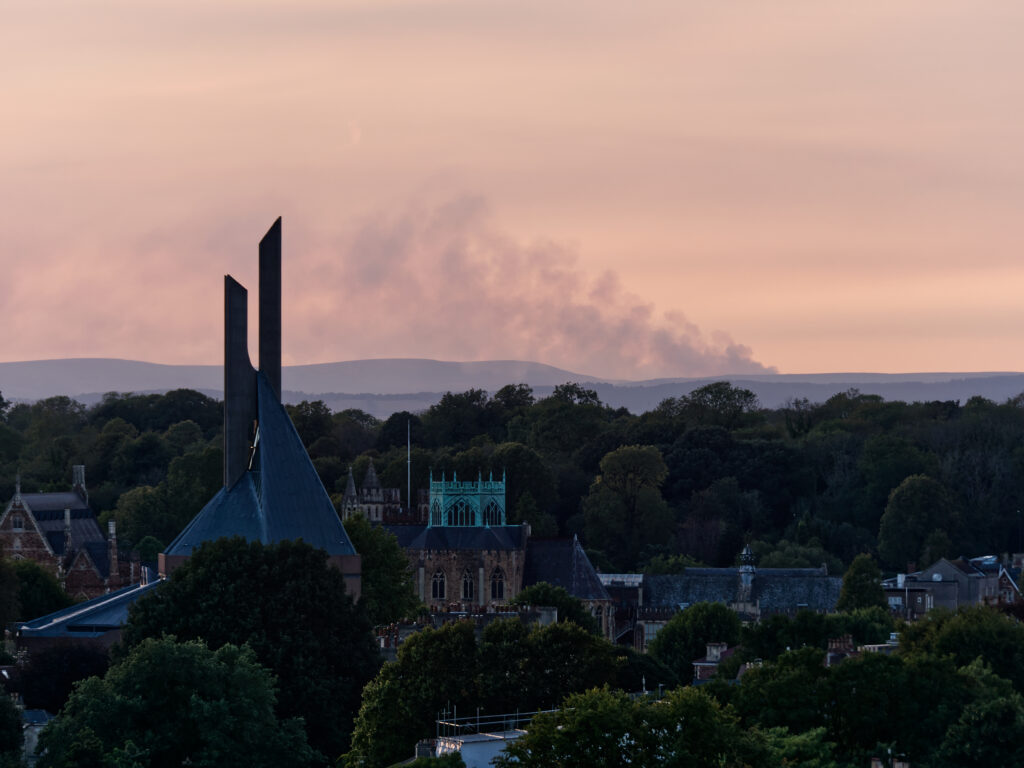
Wildfire smoke seen from Bristol this summer. Photo: Niall McLoughlin

Heat risks aren’t felt equally

The evolving story of UK heat is also exposing inequalities. The new topic thread helps to spotlight how heat, drought and fires are experienced differently due to region, income, politics, and ethnicity.

People of colour in the UK, for instance, are much more likely to report direct experience of heatwaves, wildfires and water shortages. Data and stories spotlight how children, young people and pregnant women are also particularly vulnerable to heat risks. Women are among those whose concern for the environment has spiked the most amidst this summer of heat extremes.

When it comes to political outlook, Green (59%), Plaid (55%) and Labour backers (54%) were the most likely to report personal experience of extreme heat earlier this year, while Liberal Democrats were the most likely to say they have experienced drought and water scarcity (18%).

Reform supporters diverge from the rest. As senior members of the party suggested we should all simply “enjoy” the heat this year, Reform backers were the most likely group to say they were hoping for another heatwave (42%), and least likely to say they are fearful for the future (33%).

Geography plays a role too. Plaid Cymru backers were the most likely to highlight an experience of wildfires – even ahead of this summer’s ‘firewave’, which saw a number of major fires across Wales. They are followed by SNP backers (11%) in reporting experience of fires.

To AC or not to AC?

The series of recent record-breaking summers has also sharpened policy debates about the best ways to protect people from overheating. The CCC’s report this year highlighted that 92% of the country’s homes are likely to ‘overheat’ by the middle of the century. Alongside wider investment in overheating measures, they suggest that 22% of homes may need active cooling (such as AC) to cope with 2°C of global warming.

But calls to prioritise a much wider rollout of air conditioning have increased over the past year in particular, alongside misguided claims that AC installations are being blocked by net zero policies – prompting government sources to clarify there is no ban on AC.

Last summer, Climate Barometer warned that AC was fast becoming a political dividing line across Europe, while Carbon Brief this year noted that air-conditioning has “emerged as a new front in the international “culture war” over climate action”.

In this context, multiple sources are showing how AC usage has risen over recent years in the UK. However, a passive first ‘cooling hierarchy’ continues to be recommended by scholars and practitioners to help prevent a vicious cycle where AC-led cooling worsens urban heat, strains our electricity grid, and deepens inequalities.

Nevertheless, the latest data reveals how passive approaches are already widespread and remain widely supported. Recent YouGov polling, for instance, shows that closing ‘blinds, curtains and shutters’ is the most widely used cooling method in Britain (78%).

On top of this, more people (41%) feel that issues of overheating can be solved without widespread adoption of air conditioning, than the number who feel AC would be necessary (36%). And people without AC currently continue to feel mixed about it (35% say they want it, 39% say they don’t), while views on AC’s environmental impact have been mixed since at least 2023.

The ‘cool’ responses people want to see

Beyond the AC debate – people are facing up to heat, drought and fires in a range of ways at the local level: from Birmingham schools and restaurants installing shading and adapting to the heat; to Wales, where nature-friendly farming and peatland restoration is helping to tackle wildfires and drought conditions.

These responses typify the fact that people want climate risks to be taken much more seriously – with urgent action to build resilience now seen as a ‘top priority’.

As heat requires a multifaceted approach, the rising salience of heat risks is also translating into clear support for a range of policies. There is now data showing majority-level support for maximum working temperatures, as well as wider measures such as improving access to greenspace, strengthening regulations, and making sure businesses have plans in place for when climate impacts hit.

But costs are key – with the fairness and affordability of measures remaining front and centre for many people. Ipsos report that the top reason for not making home cooling changes is “lack of affordability” (39%), while YouGov found the biggest barriers to AC were the cost of installing it (68%), alongside the cost of electricity to run it (49%). Experts have warned that unequal access to cooling measures will give rise to worsening inequalities.

With this in mind, rather than the burden falling to those worst affected, the public will be looking towards the government and the worst polluters to step up.

The new topic thread is packed full of insights, stories, commentary and media – so please explore it further to learn more about the evolving narrative on heat, drought and wildfires in the UK.

The latest from the Heat, Drought & Wildfires timeline:

Wider Context 26th August 2026

40,000 extra people died on England’s hottest days between 1988 and 2025

More than 40,000 extra people died on England’s hottest days between 1988 and 2025 compared with what would be expected in normal temperatures, according to new ONS data.

Deaths from high heat are expected to keep climbing as climate change and an ageing population combine, with older people, children and the unwell most at risk.

The strain has been visible across the health system: A&E departments saw their busiest period on record, with almost 2.5 million attendances a month in May, June and July, with record-breaking heat cited as a key factor. Nurses reported collapsing on shift amid what their union called “inhumane and impossible” conditions.

  • Source: the Guardian
  • Author: The Guardian
  • Date: 26th August 2026
Climate Barometer Tracker 25th August 2026

Experience of heat, drought and wildfires shaped by political worldview

Data from a Climate Barometer & Flooded People survey carried out in March-April 2026 shows how politics plays a clear role in reported experience of heat, drought and wildfires amongst the UK public.

Green (59%), Plaid (55%) and Labour backers (54%) were the most likely to report personal experience of heatwaves/extreme heat, while Liberal Democrats were the most likely to say they have experienced drought and water scarcity (18%).

Plaid Cymru backers were the most likely to highlight an experience of wildfires – even ahead of this summer’s ‘firewave‘, which saw a number of major fires across Wales. They are followed by SNP backers (11%) showing how geography likely plays a role here too.

Yet Reform UK backers are the ones who diverge the most – just 32% report experience of heatwaves and extreme heat – and just 3% say they have experienced wildfires.

View Heat, Drought & Wildfires timeline now

Add Feedback