• Overview
  • Aug '26
    No more polling in a vacuum: how opinion data can support people working on the frontline of climate change
  • 40,000 extra people died on England’s hottest days between 1988 and 2025
  • Experience of heat, drought and wildfires shaped by political worldview
  • YouGov tracker: Uptick in importance of ‘the environment’ amidst a summer of extremes
  • The “culture war” on AC, and why we should follow the ‘cooling hierarchy’
  • YouGov poll: Few want another heatwave, except Reform voters.
  • Public strongly back maximum workplace temperature
  • As climate impacts intensify, who should pay for the costs?
  • YouGov data: Passive cooling widespread in Britain, alongside mixed views on AC
  • Poll: Extreme heat is disrupting work, exercise and sleep.
  • Driest July in nearly 200 years, Met Office says
  • How do the public engage with climate ‘adaptation’ in 2026?
  • The Cooling Roadmap for London
  • Jul '26
    Record wildfire season hits UK and Europe
  • England on track this year for the highest number of heat-related deaths
  • Heat is making Brits more fearful of the future
  • Climate coverage hit a high in 2026 due to heatwaves
  • Child heatwave exposure in the UK already at record levels for 2026, as drownings spike
  • New MP polling as Burnham enters Number 10
  • Stories of extreme weather and local community action across the UK
  • The Birmingham school making changes to cope with heat
  • ‘Climate’ mostly absent from national media coverage of record-breaking June heatwave
  • Britons blame climate change for June 2026 heatwave
  • Parents scared for children’s safety during UK heatwaves, with some classrooms exceeding 40C
  • Poll: People’s sleep and health being impacted by extreme heat
  • YouGov: Did the June 2026 heatwave impact climate opinion?
  • Growing popularity of solar panels among UK owner-occupiers, with financial pay-off as the key swaying factor
  • Uptick in likelihood to install heat pumps among UK owner-occupiers
  • Jun '26
    How a local business in Birmingham is adapting to extreme heat
  • Britons view climate preparedness as an urgent, top priority
  • How did climate show up at the 2026 elections?
  • May '26
    The Welsh farmers tackling wildfires
  • The public want urgent action on floods, heat, and droughts
  • CCC: British way of life is under threat from heat, flooding and drought
  • Public believe climate risks are becoming more frequent and severe
  • Reform voters: getting the climate story right
  • UK regions experience heat impacts differently
  • Apr '26
    What does climate ‘salience’ mean in 2026?
  • Building regulations must change to meet rising challenges of overheating
  • Research paper: England’s heat alerts do not straightforwardly lead to behavioural changes
  • Mar '26
    Energy security: opinion insights and message testing
  • Heat resilience policies widely supported as majority continue to think UK is unprepared
  • 3 in 4 think it’s important for the UK to be a global leader on climate but only 2 in 5 say that it is
  • Has the Green Party really stopped talking about the environment?
  • Feb '26
    What locals want
  • What drives support for local energy infrastructure?
  • Clean energy is a winner across the political spectrum – but support for fossil fuels is slowly creeping upwards again
  • Varied levels of support for individual net zero policies
  • Jan '26
    Signal in the Noise: Climate opinion trends for 2025/26
  • Dec '25
    Our latest public & MP opinion data
  • Support for net zero is plateauing, not plummeting
  • Public think polluting business and industry should pay for net zero
  • Nov '25
    The Autumn Budget and public opinion – bills, taxes, and more
  • High public support for home insulation
  • MPs and the public see climate as shared global responsibility
  • The Islington Business Climate Resilience Toolkit
  • Division is growing – which makes communication on climate change more difficult
  • The government released its latest public opinion tracker figures
  • How to (not) reduce energy bills
  • What about China?
  • The 30th climate change ‘Conference of Parties’
  • Oct '25
    Tracker data: MPs continue to underestimate public support for NZ target
  • Missing Links: Connecting the ‘how’ and the ‘why’ in net zero engagement
  • Sep '25
    2025 is UK’s hottest summer on record
  • Reform urge investors to put breaks on offshore wind
  • Tories pledge to get all oil and gas out of North Sea
  • Zack Polanski elected leader of greens
  • Jul '25
    Unions demand green jobs
  • Linking impacts to net zero
  • Miliband’s ‘State of the UK’ address on climate impacts
  • Barriers to heat pump adoption
  • A climate of silence in the UK?
  • Tracker data: MPs and the public continue to underestimate local backing for wind, solar and pylons
  • Climate opinion in ‘Shattered Britain’
  • To help people prepare for extreme heat, we must communicate better
  • YouGov polling: Positivity towards heat decreased during summer of 2025
  • May '25
    How heat is putting pregnant women and newborns at serious risk
  • Perception gaps on extreme heat
  • New public polling: Behind the noise on net zero
  • Apr '25
    How AC use is changing in the UK amidst extreme heat
  • Mar '25
    What’s the public appetite for climate-friendly food choices?
  • Feb '25
    Diets shifts in the years ahead: What level of change will be needed and accepted?
  • Is the Tory leadership out of touch with Conservative voters on climate?
  • How households can make meaningful shifts towards sustainable diets and lower food waste
  • Jan '25
    Majority think UK is not prepared for climate impacts
  • Dec '24
    Signal in the Noise: Trends in the UK climate discourse in 2023/24
  • Nov '24
    Report: How politicians can change food policy in Britain
  • UK “biggest climber” on climate action as COP29 heads to a close
  • Closing gap between Labour and Conservative voters on LTNs
  • If Labour wants to move fast and build things, it’s time to stop the name calling
  • National dietary survey shows UK meat consumption is falling
  • Britons want the UK to stay committed to climate despite Trump
  • Tracker data: The public and MPs underestimate support for net zero
  • Tracker data: Huge perception gap on support for onshore wind
  • Unprecedented 2022 heatwave was experienced unevenly
  • Oct '24
    Growing calls for a ‘climate resilient net zero’
  • New study addresses impact of climate protest images on audiences
  • New study addresses global awareness of climate justice
  • Cumbria coal mine cancelled
  • MP polling: Is this the greenest parliament ever?
  • New study: Political leaders’ actions can inspire behavioural change
  • Sep '24
    Polling: Building familiarity with EVs necessary to overcome misconceptions
  • Almost half of Britons have personally experienced heat waves
  • Has support for net zero risen or fallen since the election?
  • Aug '24
    Labour’s energy policies are popular, but concerns around energy costs are growing again
  • Is ‘climate crisis’ a more effective term than ‘climate change’?
  • Jul '24
    Labour’s plans for Great British Energy brought to parliament
  • Tracker data: Renewables better for energy security than fossil fuels
  • The public feel ‘worried’, ‘sad’, and ‘no emotions’ about climate change
  • More focus needed on ethnicity and climate impacts link
  • Post-election polling shows ‘backtracking’ on net zero targets cost the Conservatives votes
  • New Labour government announces planning reforms to increase onshore wind development
  • What do MPs need to know about voters’ views on climate?
  • New Labour government elected
  • Majority of public feel accepting of local pylons
  • Tracker data: Narratives that cut through
  • Research paper: Low carbon lifestyles are supported, but are impacted by ‘narratives of delay’
  • MPs and the public underestimate public support for pylons
  • Ipsos: Most net zero policies have more support than opposition (but support for some has fallen)
  • Why better insights on ethnicity are important for climate communication
  • Jun '24
    Major global study: Four out of five want governments to strengthen climate action
  • General Election 2024: Scottish views on the North Sea transition
  • Conservative Environment Network: Polling shows climate change is not salient for Reform voters
  • Carbon Brief: General Election 2024 energy & climate manifesto tracker
  • Trust & influence: Beyond ‘trusted messengers’
  • May '24
    General Election 2024: Will culture wars win votes?
  • Tony Blair Institute survey on perceptions of net zero
  • Tracker data: How is support for phasing out petrol and diesel vehicles changing?
  • Tracker data: The public blames government and the energy system (not green initiatives) for high bills
  • Tracker data: Public dissatisfaction with politicians’ handling of climate
  • Tracker data: Majority of public think climate inaction will cost too much
  • Ipsos poll: Support for meat and dairy tax increases when positive impacts are highlighted
  • Ipsos global data shows elevated climate ‘apathy’ among younger men
  • Apr '24
    Scotland drops 2030 emissions target but retains 2045 net zero ambition
  • Tracker data: the public is split on whether climate campaigners are ‘out of touch’
  • Tracker data: What climate impacts are the public concerned about?
  • Comment: Reform voters and net zero
  • Reform voters and net zero
  • Research paper: Engaging concerned but distrustful audiences on reducing meat & dairy
  • Europe Talks Flying: Navigating public opinion on aviation and climate
  • Green Alliance policy tracker: March 2024 update
  • Research paper: Climate concern increases following major protests/civil disobedience
  • Mar '24
    What the public misunderstands about heat pumps
  • Grantham Institute survey: What benefits do people think climate policies will bring?
  • What are perception gaps and why do they matter?
  • Climate action dashboard: Trends in public opinion 2020-2023
  • Spring Budget 2024: A small number of ‘green-tinged’ measures
  • Research: Health benefits can motivate eating less meat and dairy
  • Feb '24
    Decision makers don’t feel prepared for further heat events like the summer of 2022
  • Video: People want climate action so why don’t politicians get it?
  • Survey: Three quarters of the public are worried about the impact of climate change on their bills
  • Redfield & Wilton polling: Labour & Conservative voters think climate change not being taken seriously enough
  • ECIU polling: more voters had heard about Labour’s green investment ‘U-turn’ than the policy itself
  • Voters want political leadership on climate change
  • Global study shows climate perception gaps are prevalent around the world
  • YouGov polling: Labour voters see government U-turns as a bad sign
  • Jan '24
    Tracker data: The youngest and the poorest are most worried about climate and wellbeing
  • Comment: Why should we care about climate emotions?
  • Survey: Knowing someone with a heat pump increases support
  • Differences in support for oil and gas track political divides
  • Report finds a rise in ‘new denial’ narratives on Youtube and a third of UK teenagers agreeing that climate change is exaggerated
  • Carbon Brief analysis shows record opposition to climate action by right-leaning UK newspapers in 2023
  • Research paper: Reducing inequality makes behaviour change for net zero more achievable
  • Are there gender differences in low carbon diets in the UK?
  • Dec '23
    Legal challenge launched against Rosebank North Sea oil field
  • COP28 calls for “transition away from fossil fuels”. Does the UK public agree?
  • CAAD report: A rise in violent language used online to describe protesters in 2023
  • Nov '23
    Tracker data: Nearly half of British public support climate compensation
  • Tracker data: Public oppose fracking, but it continues to polarise MPs
  • Comment: Is ‘behaviour change’ a contentious topic or an essential part of net zero?
  • Tracker data: What actions are the public and MPs taking to address climate change?
  • Tracker data: MP and public views on energy sources
  • Tracker data: Low levels of trust in political parties to speak about climate change
  • Tracker data: Who is trusted to speak honestly about climate change?
  • Making sense of public opinion on climate impacts
  • National Trust report: A Resilience Bill could put adaptation on the same footing as mitigation
  • Understanding perceptions of political leadership on climate change
  • Desmog publishes analysis of ‘anti-green’ Telegraph commentary on net zero
  • Comment: Are international climate negotiations on the public’s radar?
  • Carbon Brief analysis of the language used in the autumn statement shows change climate given a low priority
  • Tracker data: MPs and the public support high ambition on climate
  • Tracker data: MPs and public support climate finance to vulnerable countries
  • Making sense of public and MP opinion on renewables
  • Autumn Statement: Discounts on energy bills to be provided to households living near new electricity transmission infrastructure
  • Tracker data: Favourability towards wind and solar among MPs and the public
  • Making sense of public opinion on oil and gas
  • Tracker data: The public and MPs overestimate opposition to local solar
  • Carbon Brief resource: Who wants what at the COP28 climate change summit?
  • Making sense of public opinion on clean air zones
  • Tracker data: Public and MPs believe in the effectiveness of working together to tackle climate crisis
  • Tracker data: Public support for low traffic neighbourhoods is higher than MPs’
  • Reuters Institute report: UK audiences prefer climate coverage focused on ‘solutions’
  • Ipsos MORI polling ahead of COP28 shows limited public confidence that conference commitments will lead to climate action
  • Polling: Effectiveness of reducing meat consumption underestimated by UK public
  • Polling: British public are willing to change their eating habits to tackle climate change
  • Comment: Climate vs the cost of living?
  • Polling: Carbon food labelling receives clear support
  • Comment: Bumps on the road to net zero in 2023
  • ACT Climate Labs: How to talk to ‘Persuadables’ about transport
  • Tracker data: No signs of polarisation around the 2050 net zero target
  • Tracker data: Who is to blame for the high cost of energy bills?
  • Tracker data: Public and MPs underestimate net zero support
  • Conservative Environment Network polling: Widespread support for local green energy development
  • Tracker data: Public support for new local pylons
  • Comment: How does the public perceive climate protesters?
  • Oct '23
    More in Common: Labour can increase support among key Red Wall ‘Loyal Nationals’ by focusing on green investment
  • Public First polling: Delays to net zero make a party less electable
  • Tracker data: Majority of the public support a tax on frequent flyers
  • Tracker data: Do MPs see Net Zero as a vote winner or loser in Red and Blue Wall seats?
  • Making sense of differences between the public and MP opinions on oil and gas
  • UK meat consumption at lowest level since records began
  • What explains the drop in Welsh support for 20mph speed limits, shortly after their introduction?
  • MPs continue to underestimate importance of the environment for voters
  • Climate Citizens report: MPs underestimate the importance of the environment for voters
  • Conservatives urged to reconsider anti net zero strategy after Tamworth & Mid Bedfordshire by-elections
  • Comment: Net Zero in My Back Yard
  • Making sense of UK polarisation on climate change
  • Comment: What do the Tamworth and Mid Bedfordshire by-elections tell us about support for climate policies?
  • Communities near wind farms will receive £300 incentive
  • Tracker data: Public and MPs see climate action as best route to energy independence
  • Tracker data: Most believe they can make a difference on climate, but over a third don’t
  • Tracker data: MP and public opinion on government climate action
  • National Infrastructure Commission recommends low income households should be given free heat pumps
  • Map of ‘action based’ stories aims to offer hope through seeing others acting
  • Scrapping, banning or delaying? Why question wording matters for understanding opinion on net zero
  • Climate Change Committee: Net zero targets are harder to achieve after changes to policies
  • Climate change in TV and Film
  • Climate Change Committee: How behaviour change can become part of UK climate policies
  • Polling during Labour Party conference: There is support for removing fossil fuels from electricity generation by 2030
  • There is more support than opposition for a delayed phase out of petrol and diesel cars
  • New research: What personal climate actions are British people of colour undertaking?
  • Report: How people of colour are experiencing climate extremes in Britain
  • Public First: UK public backs a move towards energy independence.
  • Tracker data: Gap in perceived support for local wind and solar
  • Tracker: Buying local and reducing meat much more common than meat-free diets
  • Sep '23
    Tracker data: Most people agree it will cost too much ‘not to tackle’ climate change
  • Friends of the Earth release a map of fossil fuel extraction sites around the country
  • Onward league table shows which net zero policies are popular among voters
  • Onward polling: Voters rank green policies as the least likely reason for cost of living crisis
  • Onward research: How to build support for net zero policies among Conservative voters
  • Labour Party confirms plans for GB Energy ahead of 2023 conference
  • Rosebank oil field given go-ahead by regulators
  • YouGov: There is a generational divide in support for more oil and gas extraction
  • Greenpeace polling: Climate will influence the next election in Blue Wall constituencies
  • Public First: Sunak’s Net Zero speech may scarcely cut through to voters
  • Ipsos polling: Renewable energy infrastructure is a priority for Britons
  • Anger Monitor research: ‘constructive’ anger can motivate climate action
  • Greenpeace polling: Blue Wall constituents want subsidies for net zero policies (and will vote on climate)
  • More in Common: Most voters think the government is doing too little on climate
  • ECIU poll: net zero policy rollback viewed as ‘untrustworthy’ by most; ‘sensible’ by some
  • Support for a loophole-free windfall tax on the profits of oil and gas companies sits at nearly 90%
  • More in Common polling: Few Britons want the government to do less to reach net zero
  • Rishi Sunak announces delays to near-term net zero targets
  • Social Change Lab: Does radical action shift the perception of more moderate activists?
  • More in Common: Oil & gas are no longer seen as reliable energy sources
  • Sizewell C campaigners hail appeal court victory
  • Comment: Polling makes misleading claims about support for clean air zones and net zero
  • Is there a split between ‘motorists’ and ‘non motorists’ on transport policies?
  • Climate Change Committee: How to help the UK public prepare for climate impacts
  • Report: How behavioural science can help encourage sustainable diets
  • Do people think net zero will be expensive, or can the costs fall fairly?
  • Opinium polling: A third of young people seek counselling and medical help for eco-anxiety
  • Climate Citizens report: Sustaining the political mandate for climate action
  • Summer 2023 was the hottest on record globally
  • Aug '23
    Resources for working with climate emotions
  • Valent report: Evidence of online manipulation in the debate around ULEZ expansion
  • Understanding opinion on 15-minute neighbourhoods
  • Progressive Policy Institute report: working class voters’ views on climate policies
  • Ipsos polling: Voters have an appetite for helping the environment alongside concerns about affordability
  • Conservative Party members oppose LTNs and the phase out of petrol/diesel cars
  • Jul '23
    Desmog polling: Voters tend to support ULEZ-style policies, when it is made clear only a minority of vehicles are affected
  • More in Common research: voters outside of London were not paying close attention to the extension of ULEZ
  • International comparison: UK support for net zero policies
  • YouGov poll shows support outweighs opposition for lowering urban speed limits from 30 to 20mph
  • Onward report: Local benefits increase rural support for renewable energy projects
  • Jun '23
    ACT Climate Labs guide: How to rebut ‘what about China and India’ arguments
  • Climate Change Committee: How the government can show leadership on climate change
  • May '23
    SNP voters back a ‘rapid’ move away from oil and gas – but are more evenly split on new exploration
  • Research paper: Climate-induced migration is not a route to greater climate concern
  • YouGov tracker: Public consistently in favour of government subsidies for solar development
  • Public Order Act 2023 introduces harsher protest laws
  • Apr '23
    Tracker data: Gender divide in MPs’ beliefs about cost of climate impacts
  • Tracker data: Some public willingness to pay extra climate tax
  • More in Common: Britain’s ‘quiet majority’ want less talk and more action on green energy
  • Mar '23
    OFFSHORE documentary explores what the energy transition means for workers and communities around the North Sea
  • Most Britons want their area to become a 15 minute neighbourhood
  • Platform report: The needs of offshore workers for a just energy transition
  • Jan '23
    What shapes people’s engagement with heat risks?
  • Is tackling meat consumption too politically toxic?
  • Dec '22
    Understanding support for the frequent flyer levy
  • ECIU report: What is the cost of ‘Not Zero’?
  • Video clip testing: Voters are more likely to support Labour when they hear them talking about climate change
  • Red Cross polling: UK public unaware of flood risks and what actions to take
  • Nov '22
    Ahead of COP27, UK public sceptical that the conference would speed up climate action
  • COP27 polling: Few see Rishi Sunak as showing leadership, but most support climate funds for poorer nations
  • Ipsos MORI polling: Britons want subsidies on environmentally friendly tech (but few want higher taxes on non-renewable energy sources)
  • Oct '22
    Climate Majority project seeks to take climate action ‘outside of the bubble’
  • Tracker Methodology
  • Research paper: Media portrayal of heatwaves undermines the seriousness of heat risks
  • YouGov tracker: Wind power continues to be the most popular form of energy generation
  • Climate anxiety around the world
  • Message testing guide: How to talk about the cost of living and climate crises at the same time
  • Sep '22
    Initiative with football fans encourages meat reduction
  • Briefing paper: The road to net zero – UK public preferences for low-carbon lifestyles
  • More in Common research shows how to engage ‘Blue Wall pragmatists’ on climate change
  • Aug '22
    ACT Climate Labs: How to combat misinformation around extreme weather
  • Jul '22
    New research paper: politicians and activists ‘speak a different language’ on climate change
  • UK experiences temperatures above 40°C for the first time
  • IPPR narrative testing: Messages about impacts are one of the most persuasive arguments for action on climate change
  • Carbon Brief: How UK newspapers changed their minds about climate change
  • Jun '22
    Mapping worry about climate change
  • Research: Britons’ aspirations to reduce diet impact made more difficult by day-to-day realities
  • Ipsos poll: More support than opposition for diet-related climate policies
  • May '22
    COP26: What the public heard
  • Feb '22
    Climate Change Committee: New oil and gas fields in the North Sea will create only marginal savings for households
  • Jan '22
    Climate Emotions Wheel shows the range of climate emotions
  • Dec '21
    Research paper: Emotions as drivers of climate change opinions and actions
  • Nov '21
    Media analysis: News of protests at COP26 outstripped coverage of the conference itself
  • Ahead of COP26, Loyal Nationals express scepticism around around international cooperation
  • Oct '21
    UK government hosts the annual UN climate Conference of the Parties (COP26)
  • Global Scan polling: Most Britons want global leadership by the government on climate
  • Development Engagement Lab: Britons have greater awareness of COP26 than other countries
  • Climate Just map: Climate vulnerability in the UK
  • Government’s Net Zero strategy includes new oil & gas licensing
  • Sep '21
    Climate Outreach report: Loyal Nationals see climate change as a shared global responsibility
  • Jun '21
    Britain Talks Climate – which segments are engaging in behaviour change?
  • Research paper: High carbon lifestyles can undermine climate messaging
  • Green Alliance: The case for clean air zones
  • Jan '21
    Climate Outreach resource: Lifestyle change & system change are two sides of the same coin
  • Dec '20
    UN Environment Programme report: the importance of lifestyle change for closing the ’emissions gap’
  • Nov '20
    Clear differences between segments of British society when it comes to climate-related food choices
  • Oct '20
    Britain Talks Climate: Most people are unsure which party has best climate policies
  • Britain Talks Climate: climate change concerns us all, regardless of income, background or politics
  • Research paper: Feeling empowered and able to make a difference is key to engagement on adaptation
  • CAST data portal: support for lifestyle change in the UK (vs Brazil, China & Sweden)
  • Sep '20
    Public forums: Reducing meat as part of a balanced diet seen as achievable and desirable
  • Jul '20
    Report: National Food Strategy highlights need for long term shifts in UK’s food culture
  • Mar '20
    Guide: Engaging the public on climate impacts and adaptation
  • Cardiff University polling: concern about heat risks has increased over the past decade but floods still top the risk table
  • Jan '20
    Environment Agency report: Low income households at greatest risk from flooding
  • Nov '19
    Report: Vulnerable people don’t feel they are at risk from heat
  • Sep '19
    Climate Strike: 200 protest events in UK’s biggest environmental protest to-date
  • Aug '19
    Reuters: How Greta Thunberg’s climate strikes became a global movement in a year
  • IPCC report: Dietary changes (including eating less meat) are needed to meet global sustainability goals
  • May '19
    Poll reveals MP misperceptions over onshore wind
  • Nov '18
    ‘One thousand ways to experience loss’
Category

Uncategorized

Filter content Please note: The page will automatically update when any filters are changed or set.
    Media Insight 28th July 2026

    Climate coverage hit a high in 2026 due to heatwaves

    Media analysis by Climate News Tracker shows that climate coverage reached its highest level of 2026 during two June heatwaves. The analysis of television and radio climate coverage from UK public service media showed that climate coverage rose to 38.1% of all pieces in June, the highest point of 2026 so far.

    The research shows that extreme weather was the only story that consistently broke through in this period, while other climate stories with clear news hooks received little attention. However, the rise in climate related coverage due to heat was short-lived.

    This builds on other recent analysis by the CNT team, which showed that where people get their news shapes whether there were links to climate change or not. Climate was linked to the heatwave in 62% of TV and radio programmes, but was only referenced in 24% of online articles, and 16% of Instagram and TikTok posts covering the heatwave.

    • Source: Climate News Tracker
    • Author: Climate News Tracker
    • Date: 28th July 2026
    Wider Context 28th July 2026

    Child heatwave exposure in the UK already at record levels for 2026, as drownings spike

    In the first six months of 2026, the number of children in the UK exposed to extreme heatwaves has already exceeded the total for any previous calendar year since 1995, according to new analysis from Save the Children.

    A study of almost 2,000 drowning deaths in the UK also found that the risk of unintentional drowning increased by 7% for every 1°C rise in daily maximum temperatures, with the greatest risks on the hottest days.

    In London, child deaths linked to drowning have surged by 80% since 2023, according to the Royal Life Saving Society UK (RLSS UK), as thousands flock to lidos, open-air pools, the Thames and nearby beaches to escape the heat.

    Local Insights 20th July 2026

    Stories of extreme weather and local community action across the UK

    A new piece by Local Storytelling Exchange brings together people’s experiences of extreme weather: from tree planting to preventing waterlogged cricket pitches, to shading schools from the rising heat. Amidst growing climate impacts, Exchange are sharing stories and multimedia content to highlight how people in Britain are already adapting to extreme weather, including heatwaves, drought and floods – and spotlighting that they can’t do it alone. Here are a couple of quotes from contributors:

    “It’s really challenging when you have relatively small classrooms with up to 30 children and multiple adults. When it’s over 30 degrees in the summer, it’s suffocating.”–Rona Mackie, head teacher at Guildford Grove Primary School

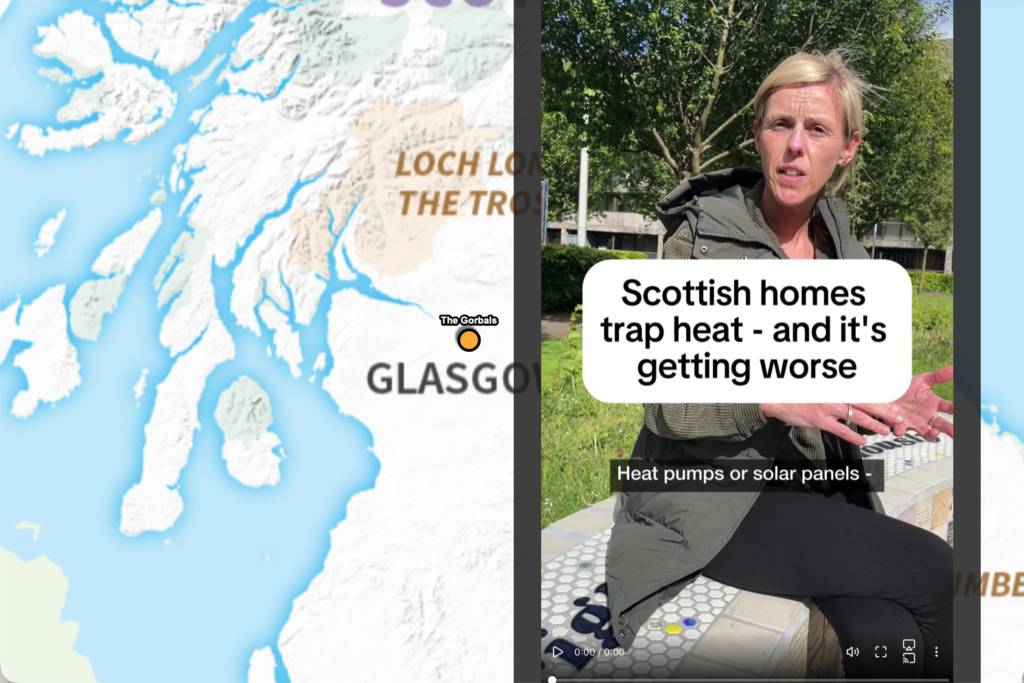
    “Houses in Scotland are built to retain heat, which is great in the winter, but it’s problematic if you’re getting temperatures of 30 degrees and your flat is sitting at 27 or 28 degrees for a few days on end. The consequences of that could be massive ” – Dani Waddell, manager of Crossroads Youth and Community Association (also covered in the Glasgow Times)

    • Author: Local Storytelling Exchange
    • Date: 20th July 2026
    Local Insights 15th July 2026

    The Birmingham school making changes to cope with heat

    Ark Tindal Primary Academy in Balsall Heath, have installed a “shade sail” to keep their pupils cool, as well as relaxing uniform rules. They are now fundriaisng to plant trees as a long-term solution. 

    Speaking about the changes, Dr Claire Smith, operations manager and sustainability lead at the school said she and her colleagues had noticed a “huge difference” since the shading canopy was installed last year:

    “We’re surrounded by brick on all sides, so it gets incredibly hot here in the summer when the sun’s beating down on the playground.” “We went out to lots of contractors – we wanted to go down a natural route so we went for a wooden structure in our [green] school colours.”

    “It’s essential to get children outside as much as possible. Their behaviour is so much better when they get the chance to run off some energy at lunchtime, so I think structures like this that make the outside accessible throughout the year make a huge difference.”

    Photo credit: Josh Neicho.

    Dr Claire Smith with pupils at the school

    • Source: Birmingham Live
    • Author: Hannah Ahmed
    • Date: 15th July 2026
    Media Insight 14th July 2026

    ‘Climate’ mostly absent from national media coverage of record-breaking June heatwave

    Media analysis by ECIU reveals that almost three quarters (72%) of articles in national newspapers which referred to “heatwave” or “extreme heat” during June’s record high temperatures didn’t include a reference to climate change. The analysis also found that less than 1 in 25 articles referring to the extreme heat and climate change additionally mentioned the phrase “net zero”. These insights come as the World Weather Attribution found climate change was “unequivocally to blame” for June’s heat conditions.

    Opinion Insight 13th July 2026

    Britons blame climate change for June 2026 heatwave

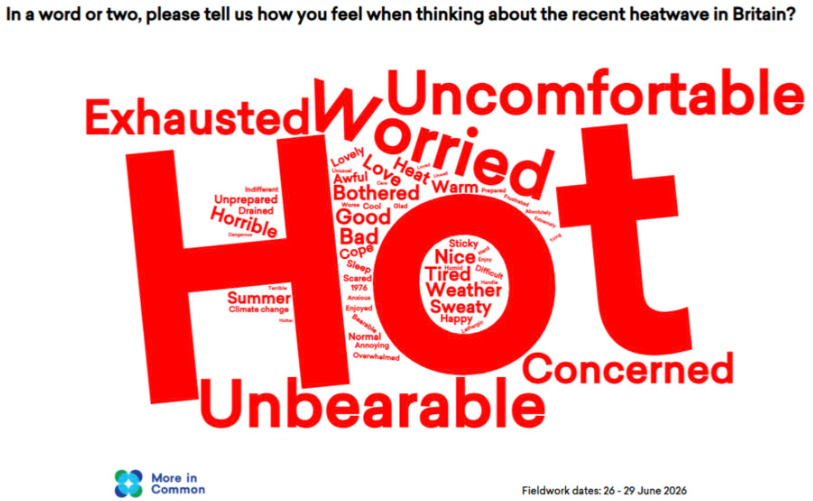
    New polling by More in Common shows that 86% of the UK public believe climate change to be either entirely or partially responsible for the June 2026 heatwave. This holds true even for those opposing net zero, with 63% of them seeing climate change as at least in part to blame for the extreme heat.

    At the same time, more than 4 in 5 think the UK is unprepared to cope with extremely hot weather (84%) and more than 3 in 4 see the country as ill-equipped to deal with water shortages and drought (77%).

    Asked about which groups they think are most negatively affected by extreme heat, the elderly (88%) and children (68%) were seen as worst impacted, closely followed by “ordinary people” (66%).

    Describing the most recent heatwave in their own words, responses revealed a public struggling to cope, with words like “hot”, “worried”, “unbearable” and “uncomfortable” being mentioned most often:

    Relatedly, the majority expect more political leadership on the issue: 59% of the public say they want the government to help people like them cope with the impacts of extreme heat, compared to 26% who think the government should do the same amount and only 5% who say the government should do less to help people like them cope.

    • Source: More In Common
    • Author: More In Common
    • Date: 13th July 2026
    Opinion Insight 8th July 2026

    Parents scared for children’s safety during UK heatwaves, with some classrooms exceeding 40C

    A survey of 1,000 UK parents during June’s heatwave found that almost two-thirds said summers in the UK were “starting to feel genuinely unsafe for children”.

    The poll, carried out by Focaldata on behalf of Round Our Way, found that more than half (53%) of parents said one or more of their children had missed, had a school/college day cancelled, been sent home early, or been told to stay at home because of the hot weather.

    The survey is shared alongside temperature sensor data showing that some classrooms climbed above 40C this summer, while several recorded more than 100 hours above 28C. These levels of heat, it is reported, has lead to pupils and staff suffering from health issues such as heatstroke, nausea and headaches.

    Many of the parents polled (40%) reported that children were coming home from school overheated and exhausted, while just under half (46%) said their children were unable to play outside because it was too hot.

    Commenting on this research, the head of the exam board Cambridge OCR highlighted the growing inequalities in learning due to heat:

    “There is the risk of an obvious fairness issue given the impact that extreme heat can have on concentration and performance. It has raised concerns that children’s concentration — and ultimately their grades — will be increasingly affected by rising temperatures, leaving schools without air conditioning at a disadvantage.”

    “For exams to continue to be fair, young people should take them in similar conditions. Sitting in a Victorian building during a heatwave will be a very different experience to a modern hall with air conditioning.”

    This new data, while alarming, is sadly is no surprise. Round Our Way have now documented classrooms reaching ‘worryingly hot’ over multiple years (see here for stories from 2024 and 2025). No safe maximum temperature exists in schools still, despite a 26C maximum temperature long advised by the National Education Union (NEU).

    • Author: Round Our Way / Focaldata
    • Date: 8th July 2026
    Opinion Insight 7th July 2026

    Poll: People’s sleep and health being impacted by extreme heat

    Polling by YouGov for Greenpeace has shed light on how people’s sleep, health, and work were disrupted by June’s heatwave across the UK:

    • 65% of UK adults struggled to sleep during the heatwave, with nearly half (48%) of those losing three or more hours sleep each night
    • Just under a quarter (23%) said they or someone in their household felt physically unwell because of the heatwave
    • 60% of workers said their workplaces were uncomfortably hot
    • More than a quarter of workers (27%) admitted they were less productive, and 9% reporting they worked in unsafe conditions

    There was clear support when it comes to improving heat policies and structural measures:

    ● Over half of respondents (56%) said their homes need retrofit upgrades to cope with future heatwaves – yet 78% would struggle to afford them.

    ● Almost half (46%) of UK adults said they would support a levy on high-carbon emitting companies to fund these essential upgrades.

    ● 22% of UK adults were forced to throw away food that spoiled in the heat, went off sooner than expected or couldn’t be kept cool – compounding cost-of-living pressures.

    Opinion Insight 2nd July 2026

    YouGov: Did the June 2026 heatwave impact climate opinion?

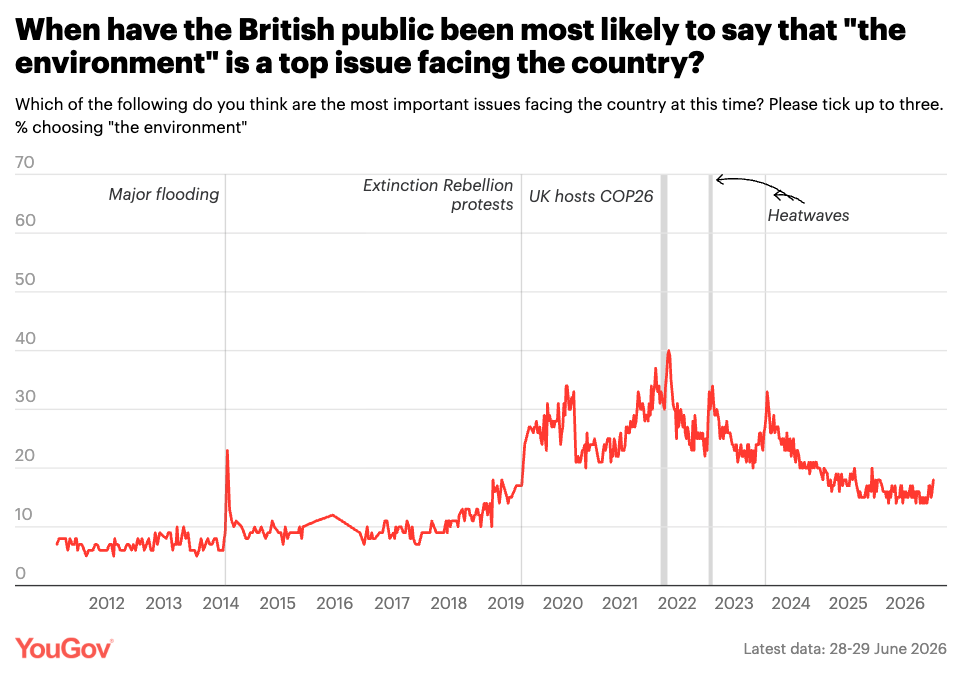
    This YouGov piece suggests that the June 2026 heatwave has not had a clear impact on issue salience, climate policy support or public actions – despite most (71%) believing climate change played a role. The piece also suggests that the number of Britons concerned about climate change following major heatwaves does not differ compared to other temperatures and times of year.

    Alongside this however, the piece shows how past extreme weather events – including the 2022/2023 heatwaves, and major flooding in 2014 – have lead to clear spikes in the salience of ‘the environment’ as top a national issue. It is possible that further heat episodes this summer may lead to a spike in issue salience.

    But any influence of specific climate impacts should not be overstated either, as they tend to lead to short-lived spikes and they are not the only thing that shifts the dial: The data shows that longer-term campaigning across the climate movement (e.g. the various climate protests around 2019) and major events (such as the UK’s hosting of COP26) tend to have a more sustained effect on issue salience.

    • Source: YouGov
    • Author: YouGov
    • Date: 2nd July 2026
    Opinion Insight 2nd July 2026

    Growing popularity of solar panels among UK owner-occupiers, with financial pay-off as the key swaying factor

    New data from the spring 2026 wave of the DESNZ Public Attitudes Tracker shows that 1 in 10 owner occupiers have already installed solar panels on their home and a further 57% say they would definitely or probably do so in the next few years. This presents an increase from 52% who said the same in spring 2025 but is still slightly below peak values in spring 2023.

    When asked about the main reasons for considering solar, those who were likely to install them listed cutting electricity bills (83%), the renewable nature of the technology (72%) and reduced dependence on the electricity grid (51%).

    Among owner occupiers who were unlikely to install solar panels, the main reasons for not considering the technology were the installation being too expensive (55%) and the payback taking too long (53%).

    When asked what would encourage them to consider getting solar, 3 in 4 owner-occupiers named better financial support for installation (75%), followed by a guarantee scheme to cover any faults or damage (50%) and better financial incentives to sell excess electricity back to the grid (44%). These three incentives remain unchanged as top 3 since spring 2024, emphasising that the high outlay cost remains the largest barrier for those eligible to install solar on their homes.

    • Source: GOV.UK
    • Author: DESNZ
    • Date: 2nd July 2026
    Opinion Insight 2nd July 2026

    Uptick in likelihood to install heat pumps among UK owner-occupiers

    New data from the spring 2026 wave of the DESNZ Public Attitudes Tracker shows owner-occupiers are now more likely to say they already have or are likely to install a heat pump when they next need to change their heating system or boiler.

    26% now say they have either already installed an air source heat pump or are very or fairly likely to install one when their heating system next needs upgrading. This is up 6 percentage points from the winter 2021 baseline and equals the previous peak from spring 2025. Change appears to be largely driven by fewer people saying they don’t know enough about the heating technology, now at 21%, which equals values in spring and summer 2025 but is down from 39% in winter 2021.

    The share of owner-occupiers who say they are likely to install a ground source heat pump is lower, though an uptick from summer and winter 2025 is also observable here: 17% say they either already have or are very or fairly likely to install the technology next time their heating system needs upgrading, close to the highest point of 18% from spring 2025.

    • Source: GOV.UK
    • Author: DESNZ
    • Date: 2nd July 2026
    Local Insights 24th June 2026

    How a local business in Birmingham is adapting to extreme heat

    Amidst ‘red’ level heat warnings, a dim sum restaurant in Birmingham’s Chinatown has made significant changes to ensure it can stay open, and it’s workers stay cool. This includes replacing fridges, installing fans, as well as providing water and cool spaces so staff don’t overheat. The story covered by Channel 4 News was made possible by the work of Local Storytelling Exchange.

    Opinion Insight 15th June 2026

    Britons view climate preparedness as an urgent, top priority

    New survey data shows that nearly three quarters (71%) believe the government should make adapting to climate risks like floods, heat, and droughts an “urgent, top priority”, while only a minority (15%) disagreed.

    The findings, from a nationally representative UK survey in collaboration with Flooded People, highlight the public desire for action on impacts like floods, storms, heat and drought.

    While experts in the climate sector separate out ‘adaptation’ and ‘mitigation’, our new data shows that a majority (55%) think these two broad responses should be prioritised equally (echoing our previous tracker insights).

    The survey also showed that most people report one or more direct experience of climate impacts. Heatwaves and extreme heat are the most commonly experienced climate impact (felt by 46%). A third have experienced ‘severe storms’ (30%), and a fifth say they have been directly affected either by flooding or poor air quality (both 21%). It’s less than a third (29%) who still say they have “no experience of impacts” at all.

    Local Insights 24th May 2026

    The Welsh farmers tackling wildfires

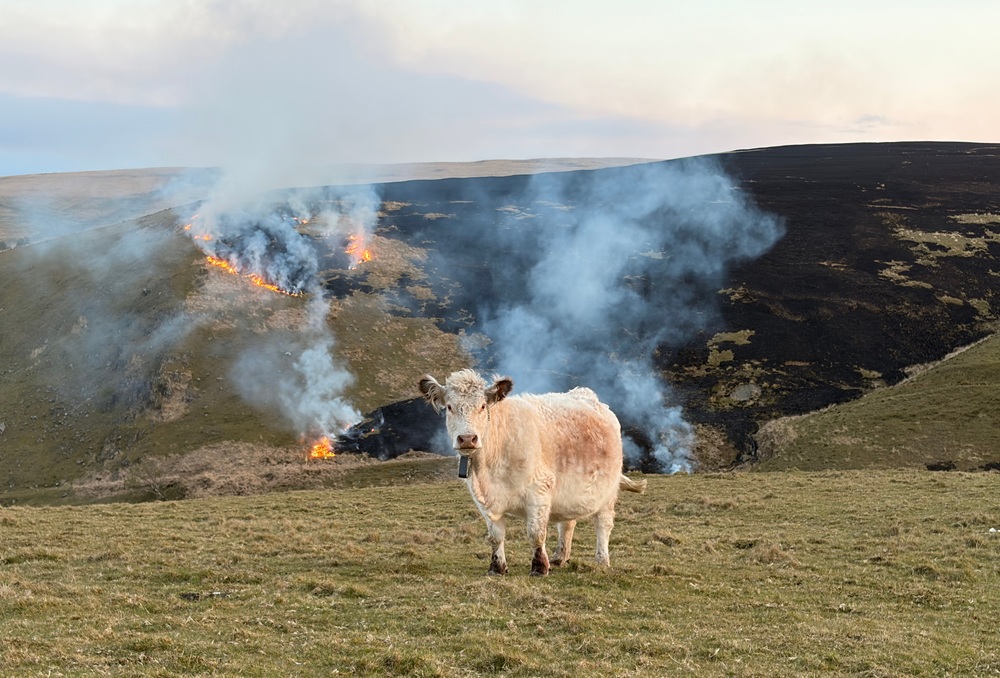
    Welsh farmers are showing how nature-based approaches can help prevent the spread of wildfires. In Elan Valley, farmer Sorcha Lewis watched a wildfire descend from the uplands to the back of her house. But amidst the devastation, one piece of land stayed untouched: a section of peatland that had recently been re-wetted. This story, which offers insights into positive ways forward for upland farming, was published widely – including on Nation Cymru (see here for a video by Local Storytelling Exchange). This echoes other stories of fire-sensitive farming in Wales, such as the ‘cow firefighters’ who keeping the Gower common safe from wildfires (see ITV Wales coverage here).

    Photo credit: Sorcha Lewis

Loading more posts...

Add Feedback