But this isn’t the full picture.
Climate, nature and environment did emerge as key talking points in the Green’s media interviews and debates during the campaign. For instance, during the BBC’s candidates debate, Spencer linked the cost of living with energy prices, highlighting how the Greens would nationalise energy industries, while challenging the other parties on donations from fossil fuel companies.
In other media appearances, Spencer talked about a range of local and national environmental issues, from poor air quality in Manchester, to insulation and fuel poverty – framing nature and environment as ‘every day parts of life’. She emphasised how she will be ‘really firm’ on the climate emergency, particularly on climate impacts like flooding and impact on green spaces.
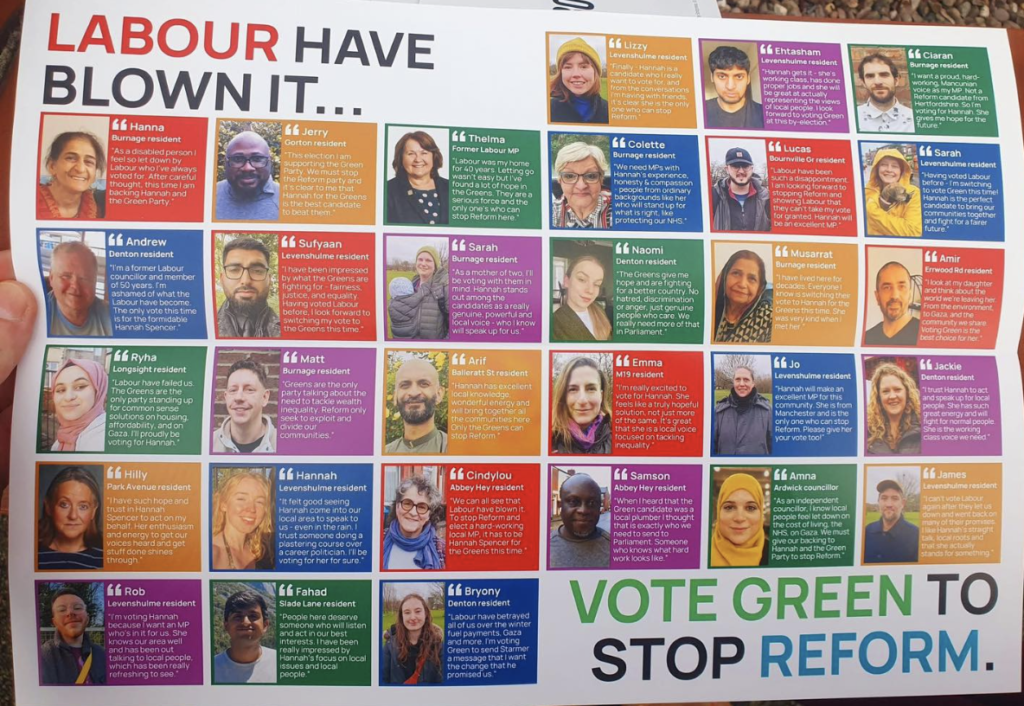
In the leaflets we analysed, there was a clear focus on local-level green policy issues, like waste and water, including fly tipping, recycling and water companies (52 mentions); local transport and planning issues – such as bus services (19); as well as the need to protect the local environment, green spaces and wildlife (18).
And what the Greens have consistently talked about are themes of local community action, collective agency, building hope, and standing up for people’s concerns and worries. Across the same 21 leaflets, the word “local” was used 74 times, “residents” 65 times, “people” 59 times, “services” 28 times, “community” 27 times, and “hope” 17 times.
These themes are crucial precursors to rebuilding trust and showing public audiences that climate and net zero policies can be fair and affordable: as Professor Mat Paterson at the University of Manchester put it in his own analysis of Green Party literature in the by-election, “Perhaps this tells us that the way to communicate climate action effectively is through focusing on everyday lives, on enabling people to thrive, and how climate action contributes to that.”
In fact, rebuilding the ‘salience’ of climate change as an issue depends on getting this right.
Rebuilding climate salience – getting the balance right
In one sense, the focus on building trust and the economic credibility of a Green candidate is a positive step: the Green party still has strong Green policies after all, and a vote for a party named after its environmental credentials is difficult to interpret as an anti-climate position.
If climate change becomes implicit in voting patterns, is that a sign of failure or of progress?
We certainly need more ‘trusted messengers’ to communicate climate policies.
But in one way or another they do need to communicate about them, to ensure climate change doesn’t drop down the political priority list, or signal to voters that climate change isn’t an urgent challenge.
If the Green party is choosing to do this less in their narrative (taking the support for climate policies among their audiences as a ‘given’), is a bolder positioning on climate change a space other parties can and should move into?
The Green Party’s communication strategy could be viewed as both a cause and a consequence of the dwindling ‘issue salience’ of climate change in the public mind. In the period spanning 2019-2021, nearly a third of people selected climate change as one of the top three most important issues facing the country. Today, that number is closer to one-in-ten.
But what does this mean? Have people stopped caring about climate change? Or does caring about climate change manifest in different ways?
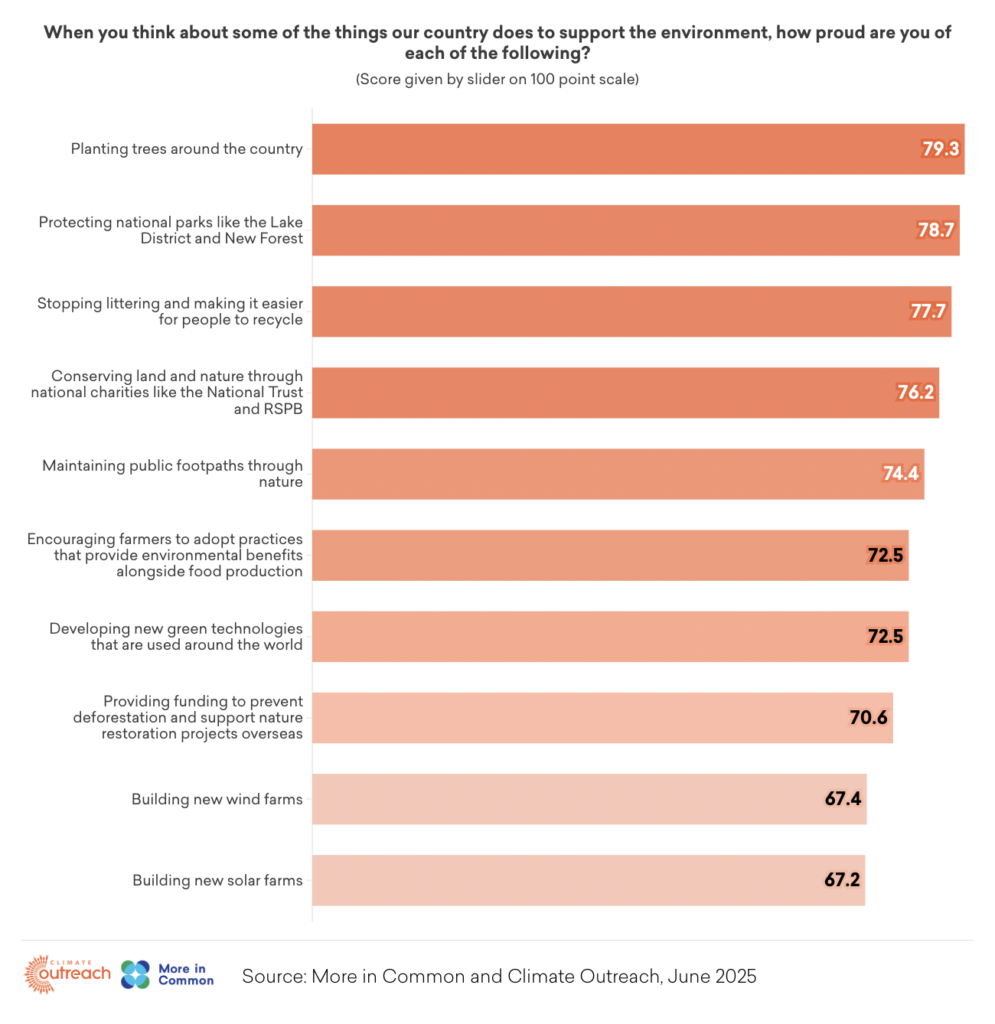
The evidence here is not difficult to decode. Britain Talks Climate & Nature shows unequivocally that people care about nature, green spaces, wildlife and preserving a healthy environment for future generations.

Signal in the Noise: Climate opinion trends for 2025/26
Signal in the Noise is Climate Barometer’s annual publication that monitors and makes sense of patterns and trends in opinion on climate change