Climate Impacts

Heat resilience policies widely supported as majority continue to think UK is unprepared

16 March 2026

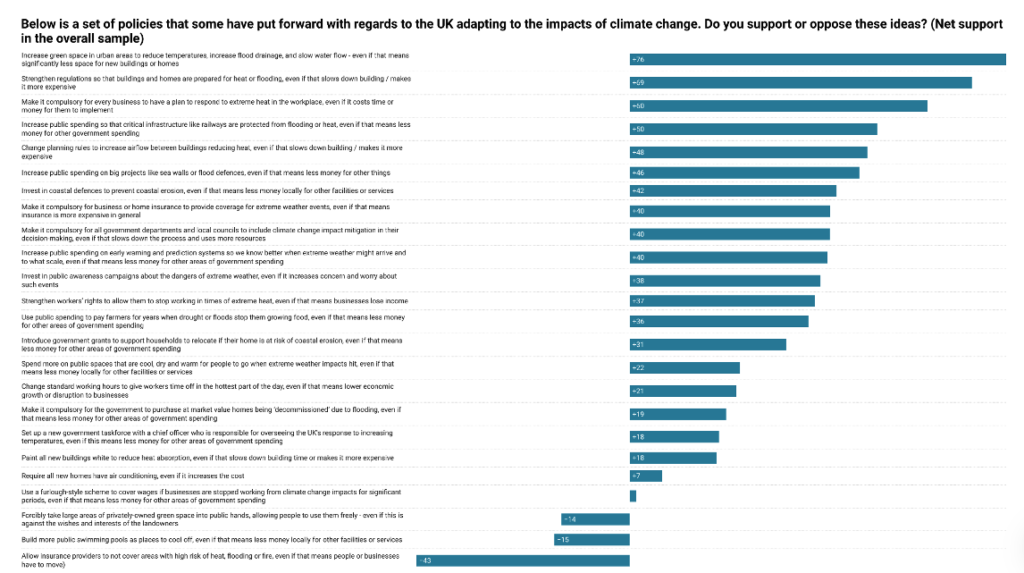
Polling by IPPR and Persuasion UK has highlighted high levels of net support for heat and flood adaptation policies in the UK. The policies receiving the highest net support were:

  • Increasing green space to reduce temperatures, increase flood drainage, and slow water flow, even if that means significantly less space for new buildings or homes (+76% net support)
  • Strengthen regulations so that building and homes are prepared for heat or flooding, even if that slows down building/makes it more expensive (+69%)
  • Make it compulsory for every business to have a plan to respond to extreme heat in the workplace, even if it costs time or money for them to implement (+60%)

The poll also found that 81% of people feel the UK is unprepared for the worst impacts of climate change, although 59% of people think it’s not yet too late to avoid the worst impacts.

When it comes to climate adaptation vs. reducing emissions, just  5% of people say they would prioritise adaptation alone.

This builds on previous polling by Climate Barometer showing that the majority of people feel the UK is not well prepared for climate impacts, and most feel climate adaptation is equally important alongside the shift to clean energy.

Reference article:

  • Authors: Sam Alvis, Sofie Jenkinson
  • Date: 16th March 2026

The latest from the Climate Impacts timeline:

Opinion Insight 3rd August 2026

How do the public engage with climate ‘adaptation’ in 2026?

A new research output by Climate Outreach shows that support for adaptation action significantly increases when people are shown tangible solutions, such as heat-proofing our homes and restoring natural flood defences.

The piece – based on a survey of 7,000 people across Britain (carried out in 2025) and in-depth focus groups across the UK (done in 2026) found that:
  • Three-quarters of people (75%) believe the government needs to take climate change “seriously” – this means a focus preparing for the worst impacts of climate change, for instance, by making our homes more suited for the heat, and building better flood defences.
  • Most people give equal support for actions that count as adaptation and mitigation. A majority recognises that both adapting to intensifying climate impacts and lowering our future carbon emissions are of equal importance.
  • The terms ‘climate adaptation’ and ‘climate resilience’ aren’t widely understood. Only half of people know what ‘climate adaptation’ means, whilst less than half know what ‘climate resilience’ is.
  • The way climate adaptation is framed makes a huge difference to how much people support it. The more we explain what adaptation actions are and why we are doing them, the more people support the action.

The findings echo Climate Barometer tracker data which shows that adaptation and mitigation are supported equally, as well as past research by Climate Outreach/Cardiff University showing that the public see these broad responses as ‘two sides of the same coin’.

  • Source: Climate Outreach
  • Author: Climate Outreach
  • Date: 14th July 2026
View Climate Impacts timeline now

Add Feedback