• Overview
  • Aug '26
    As climate impacts intensify, who should pay for the costs?
  • How do the public engage with climate ‘adaptation’ in 2026?
  • Jul '26
    Stories of extreme weather and community action across the UK
  • Jun '26
    Britons view climate preparedness as an urgent, top priority
  • May '26
    The public want urgent action on floods, heat, and droughts
  • CCC: British way of life is under threat from heat, flooding and drought
  • Public believe climate risks are becoming more frequent and severe
  • Mar '26
    Heat resilience policies widely supported as majority continue to think UK is unprepared
  • Sep '25
    2025 is UK’s hottest summer on record
  • Jul '25
    Linking impacts to net zero
  • Miliband’s ‘State of the UK’ address on climate impacts
  • Jan '25
    Majority think UK is not prepared for climate impacts
  • Oct '24
    Growing calls for a ‘climate resilient net zero’
  • Sep '24
    Almost half of Britons have personally experienced heat waves
  • Apr '24
    Tracker data: What climate impacts are the public concerned about?
  • Nov '23
    Making sense of public opinion on climate impacts
  • National Trust report: A Resilience Bill could put adaptation on the same footing as mitigation
  • Oct '23
    Report: How people of colour experience climate change in Britain
  • Sep '23
    Tracker data: Most people agree it will cost too much ‘not to tackle’ climate change
  • Climate Change Committee: How to help the UK public prepare for climate impacts
  • Summer 2023 was the hottest on record globally
  • May '23
    Research paper: Climate-induced migration is not a route to greater climate concern
  • Apr '23
    Tracker data: Gender divide in MPs’ beliefs about cost of climate impacts
  • Jan '23
    What shapes people’s engagement with heat risks?
  • Dec '22
    Red Cross polling: UK public unaware of flood risks and what actions to take
  • Oct '22
    Research paper: Media portrayal of heatwaves undermines the seriousness of heat risks
  • Aug '22
    ACT Climate Labs: How to combat misinformation around extreme weather
  • Jul '22
    UK experiences temperatures above 40°C for the first time
  • IPPR narrative testing: Messages about impacts are one of the most persuasive arguments for action on climate change
  • Oct '21
    Climate Just map: Climate vulnerability in the UK
  • Oct '20
    Research paper: Feeling empowered and able to make a difference is key to engagement on adaptation
  • Mar '20
    Guide: Engaging the public on climate impacts and adaptation
  • Cardiff University polling: concern about heat risks has increased over the past decade but floods still top the risk table
  • Jan '20
    Environment Agency report: Low income households at greatest risk from flooding
  • Nov '19
    Report: Vulnerable people don’t feel they are at risk from heat
  • Nov '18
    ‘One thousand ways to experience loss’
Topic

Climate Impacts

Filter content Please note: The page will automatically update when any filters are changed or set.
  • In Brief

    The UK is already experiencing serious climate impacts, including floods, storms, heatwaves and droughts. The 2015-16 winter floods alone cost the UK an estimated £1.6bn, and summer 2022 saw temperatures exceed 40C for the first time, resulting in the highest number of UK deaths from heat extremes. 

    The number of people who recognise that climate change is happening ‘here and now’ has steadily risen.

    But despite more and more extreme weather events taking place, a sense of disconnection remains in the UK: heatwaves continue to be represented in the media as positive occurrences, and the government’s advisers on adapting to climate change have repeatedly warned that the country is poorly prepared for the increased risks from floods, extreme heat, and storms.

    Few will have failed to notice global changes in extreme weather: floods wreaking destruction in Pakistan and North Africa; unprecedented wildfires in Canada.

    But are opinions keeping pace with a rapidly changing climate?

  • Opinion Insight 3rd August 2026

    How do the public engage with climate ‘adaptation’ in 2026?

    A new research output by Climate Outreach shows that support for adaptation action significantly increases when people are shown tangible solutions, such as heat-proofing our homes and restoring natural flood defences.

    The piece – based on a survey of 7,000 people across Britain (carried out in 2025) and in-depth focus groups across the UK – found that:

    • Three-quarters of people (75%) believe the government needs to take climate change “seriously” – this means a focus preparing for the worst impacts of climate change, for instance, by making our homes more suited for the heat, and building better flood defences.
    • Most people give equal support for actions that count as adaptation and mitigation. A majority recognises that both adapting to intensifying climate impacts and lowering our future carbon emissions are of equal importance.
    • The terms ‘climate adaptation’ and ‘climate resilience’ aren’t widely understood. Only half of people know what ‘climate adaptation’ means, whilst less than half know what ‘climate resilience’ is.
    • The way climate adaptation is framed makes a huge difference to how much people support it. The more we explain what adaptation actions are and why we are doing them, the more people support the action.

    The findings echo Climate Barometer tracker data which shows that adaptation and mitigation are supported equally, as well as past research by Climate Outreach/Cardiff University showing that the public see these broad responses as ‘two sides of the same coin’.

    • Source: Climate Outreach
    • Author: Climate Outreach
    • Date: 14th July 2026
    Local Insights 20th July 2026

    Stories of extreme weather and community action across the UK

    A new piece by Local Storytelling Exchange brings together people’s experiences of extreme weather: from tree planting to preventing waterlogged cricket pitches, to shading schools from the rising heat. Amidst growing climate impacts, Exchange are sharing stories and multimedia content to highlight how people in Britain are already adapting to extreme weather, including heatwaves, drought and floods – and spotlighting that they can’t do it alone. Here are a couple of quotes from contributors:

    “It’s really challenging when you have relatively small classrooms with up to 30 children and multiple adults. When it’s over 30 degrees in the summer, it’s suffocating.”–Rona Mackie, head teacher at Guildford Grove Primary School

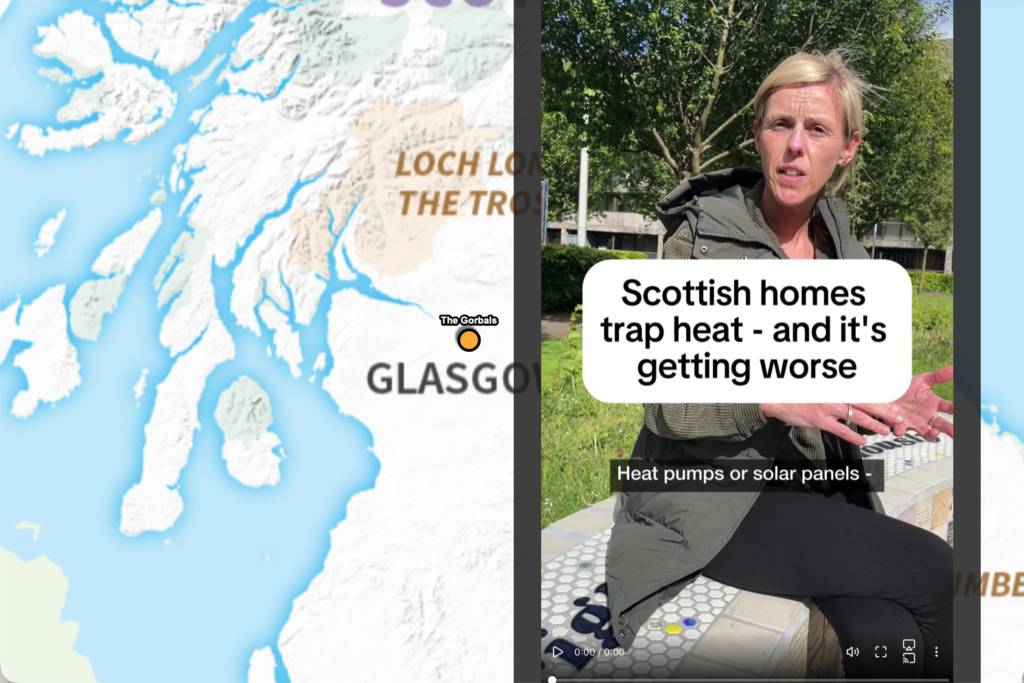
    “Houses in Scotland are built to retain heat, which is great in the winter, but it’s problematic if you’re getting temperatures of 30 degrees and your flat is sitting at 27 or 28 degrees for a few days on end. The consequences of that could be massive ” – Dani Waddell, manager of Crossroads Youth and Community Association (also covered in the Glasgow Times)

    • Author: Local Storytelling Exchange
    • Date: 20th July 2026
    Opinion Insight 15th June 2026

    Britons view climate preparedness as an urgent, top priority

    New survey data shows that nearly three quarters (71%) believe the government should make adapting to climate risks like floods, heat, and droughts an “urgent, top priority”, while only a minority (15%) disagreed.

    The findings, from a nationally representative UK survey in collaboration with Flooded People, highlight the public desire for action on impacts like floods, storms, heat and drought.

    While experts in the climate sector separate out ‘adaptation’ and ‘mitigation’, our new data shows that a majority (55%) think these two broad responses should be prioritised equally (echoing our previous tracker insights).

    The survey also showed that most people report one or more direct experience of climate impacts. Heatwaves and extreme heat are the most commonly experienced climate impact (felt by 46%). A third have experienced ‘severe storms’ (30%), and a fifth say they have been directly affected either by flooding or poor air quality (both 21%). It’s less than a third (29%) who still say they have “no experience of impacts” at all.

    Policy Insight 20th May 2026

    CCC: British way of life is under threat from heat, flooding and drought

    The Climate Change Committee published its latest stock take of climate preparedness, painting a stark picture of floods, heat risks and possible water shortages in the UK – while emphasising how much can still be done to support, protect and prepare communities.

    ‘A Well-Adapted UK’ highlights that 92% of the country’s homes are likely to ‘overheat’ by the middle of the century – while peak river floods could be 45% higher, and water shortfalls could exceed five billion litres per day. Inaction could cost anywhere between £60-£260 billion per year.

    A citizens’ panel, published alongside this report, found that people people want to see adaptation happening now and for it to be done ‘properly’, with long-lasting preventative solutions that limit harm to no more than what is already being experienced.

    The stocktake points towards a range of key policy measures needed to improve UK resilience to rising climate impacts, including:

    • Greater investment in cooling – including air conditioning, heat pumps and green shading – across key public services, alongside  national maximum temperature for workplaces to protect workers’ safety.
    • Increasing flood risk investment to around £1.6–£2.2 billion each year across the UK to prevent risks increasing further, and avoiding new construction where flood risks are not adequately reduced.
    • Taking substantial actions now to avoid water shortages, such as a strong regulatory focus on drought, scaling up sustainable water storage, accelerating leakage reduction and cutting water demand.
    Opinion Insight 18th May 2026

    Public believe climate risks are becoming more frequent and severe

    New data from Public First shows that the public believe that climate risks –  are becoming more frequent and severe. Nine in ten (87%) expecting the UK to be impacted again in the next five years.

    The public feel the UK is least prepared for flooding (70% said not prepared), closely followed by heatwaves (68%). Dry spells and drought (66%), wind storms (66%), and cold snaps (57%) were also seen as areas of unpreparedness.

    Most believe that better planning could reduce the severity of weather impacts, but many are not sure what that looks like in practice. When asked directly, a majority (60%) say it is ‘possible’ to reduce the effect of climate impacts, but they are uncertain of how.

    • Source: Public First
    • Author: Amy Norman
    • Date: 18th May 2026
    Opinion Insight 16th March 2026

    Heat resilience policies widely supported as majority continue to think UK is unprepared

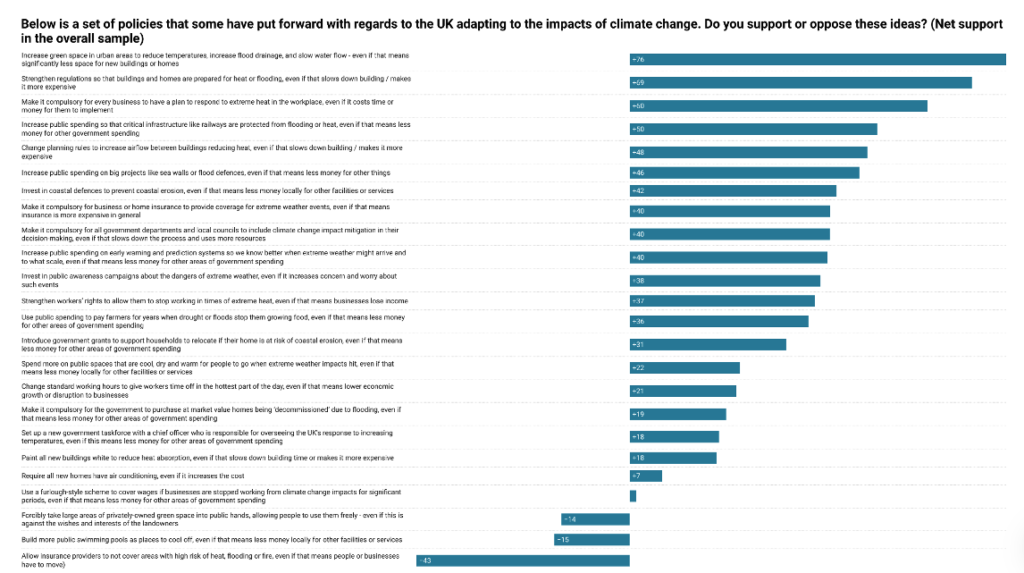
    Polling by IPPR and Persuasion UK has highlighted high levels of net support for heat and flood adaptation policies in the UK. The policies receiving the highest net support were:

    • Increasing green space to reduce temperatures, increase flood drainage, and slow water flow, even if that means significantly less space for new buildings or homes (+76% net support)
    • Strengthen regulations so that building and homes are prepared for heat or flooding, even if that slows down building/makes it more expensive (+69%)
    • Make it compulsory for every business to have a plan to respond to extreme heat in the workplace, even if it costs time or money for them to implement (+60%)

    The poll also found that 81% of people feel the UK is unprepared for the worst impacts of climate change, although 59% of people think it’s not yet too late to avoid the worst impacts.

    When it comes to climate adaptation vs. reducing emissions, just  5% of people say they would prioritise adaptation alone.

    This builds on previous polling by Climate Barometer showing that the majority of people feel the UK is not well prepared for climate impacts, and most feel climate adaptation is equally important alongside the shift to clean energy.

    • Authors: Sam Alvis, Sofie Jenkinson
    • Date: 16th March 2026
    Wider Context 4th September 2025

    2025 is UK’s hottest summer on record

    Following months of sweltering heatwaves, record-breaking wildfires and five regions in drought, this week it was provisionally confirmed that 2025 was the UK’s hottest summer on record.

    While this new record  was made ‘70 times’ more likely by climate change, the overwhelming sentiment is that the country is not prepared for more summers like this. The UK’s official climate advisors, practitioners who work on the frontline of the heatwave response, and the British public all agree that the UK isn’t ready for more extreme weather,worsening heat, and compounding risks like water scarcity and wildfires.

    At the same time, there are important perception gaps to address. Despite the alarming statistics about heat-related deaths in the UK, many people were looking forward to the first heatwaves this summer. Lots think that heatwaves will only become a problem for the UK in the future. And many believe that hot weather poses more of a risk to other people, not themselves.

    In this context there are important conversations now happening about how to grapple with the growing climate risks in the UK, including the sudden lurch towards air conditioning (despite its potential to make heat risks worse).

    For more on the key issues surrounding heat communication, check out our recent opinion piece in Climate Home News.

    Opinion Insight 29th July 2025

    Linking impacts to net zero

    The link between climate impacts and net zero isn’t always easy to explain, but it matters. We need to cut emissions to limit the worst effects of climate change. But for many people, the link between net zero and real-world impacts like extreme heat or flooding can feel abstract or distant. So how can we make the link?

    As part of his first annual climate statement to Parliament, Miliband warned that the climate crisis cannot be ignored. He called out politicians rejecting net zero as “betraying future generations” and said the shared commitment to tackling climate change “must not disappear by default”.

    Climate action as a way of staying true to future generations echoes the public’s view on why tackling climate change matters. As Climate Barometer data shows, when asked what they thought were the most convincing arguments for pursuing net zero, Britons were most likely to select the idea that “We owe it to our children and grandchildren to take action to reduce our emissions now; otherwise it is they who will suffer the most” (35%).

    This focus on protecting future generations also aligns with what makes climate change feel most urgent to people. New research shows that presenting climate impacts in binary terms is more effective in making it seem more real and imminent than showing average trend data. As extreme weather events gradually become more frequent and severe due to climate change, people tend to become accustomed to the new normal, also called the ‘boiling frog’ effect, and struggle to identify abnormal weather patterns over time.

    Presenting climate change in binary terms helps to overcome that. In the study, people found a graph showing whether a fictional lake froze each winter more impactful than a chart of rising average temperatures in a fictional town. This research highlights how important it is to use clear before-and-after examples when talking about climate impacts.

    Alongside message testing which suggests it’s helpful to frame climate impacts as “unnatural disasters” while making clear links to policies, these insights could help make climate communication resonate with the British public’s real and sustained concerns.

    Opinion Insight 29th July 2025

    Miliband’s ‘State of the UK’ address on climate impacts

    As the UK’s third summer heatwave drew to a close, Ed Miliband used his first annual climate statement to Parliament to warn of the growing impacts of climate breakdown in the UK, backed by the Met Office’s latest State of the UK Climate report.

    The report shows how extreme weather is now the norm in the UK, with data from hundreds of weather stations revealing that the hottest days are becoming more frequent and severe, and intense rainfall has increased.

    • Source: UK Parliament
    • Author: UK Parliament
    • Date: 14th July 2025
    Climate Barometer Tracker 21st January 2025

    Majority think UK is not prepared for climate impacts

    An overwhelming majority of the public think the UK is not well prepared to deal with climate change impacts and extreme weather, such as flooding, storms and droughts.

    The latest Climate Barometer tracker data shows that only 16% agreed with the statement that “The UK is making good progress in terms of adapting to the risks posed by climate change impacts”, while 39% disagreed.

    More than two thirds (68%) believed that flooding was “the most pressing to deal with in the UK”. This was followed by concerns about sea level rising and coastal erosion; loss of species, habitats and threats of extinction (both 45%); and severe storms (44%).

    Policy Insight 24th October 2024

    Growing calls for a ‘climate resilient net zero’

    In the face of rising climate impacts, UK-based researchers are calling for more measures that simultaneously tackle the root causes of climate change, while enabling society to adapt.

    Efforts to tackle climate change have tended to prioritise mitigation (reducing emissions) over adaptation efforts (reducing vulnerabilities), and these two broad types of measures are often split across government departments, such as Defra and DESNZ in the UK. 

    But new research, using the UK’s record-breaking 40C heatwave in 2022 as a case study, has found clear demands for national and local governments to roll out measures that combine mitigation and adaptation.

    Policy-makers, climate organisations, and those working in emergency response felt that approaches – such as creating climate-resilient neighbourhoods, tree-planting and other nature-based solutions – should be a priority, given their dual benefits. They felt efforts to combine emissions reductions and adaptation have challenges, but were feasible, with better coordination.

    The new analysis also suggests that framing these efforts as part of working towards a ‘climate resilient net zero’ can be a useful way of engaging a range of relevant audiences and decision-makers – building on existing support for net zero.

    The study findings are supported by Climate Barometer tracker insights, which shows that both the public and MPs feel mitigation and adaptation are equally important. It also echoes previous work which found that the public view mitigation and adaptation as “two sides of the same coin”.

    • Source: Grantham Research Institute on climate change and the environment
    • Authors: Candice Howarth, Niall McLoughlin, Ellie Murtagh, Andrew P. Kythreotis, James Porter
    • Date: 21st October 2024
    Climate Barometer Tracker 18th September 2024

    Almost half of Britons have personally experienced heat waves

    When asked about their personal experiences of climate impacts, large proportions of the public have experienced heat waves, extreme heat, storms, and flooding. Of these, heat is the most commonly experienced climate impact, with almost half of Britons surveyed saying they had personally experienced it.

    Only 28% of people surveyed in the Climate Barometer Tracker in April 2024 said that they ‘have never experienced any of these climate events’.

    Climate Barometer Tracker 19th April 2024

    Tracker data: What climate impacts are the public concerned about?

    In terms of the impacts of extreme weather and climate change-related effects, the public is primarily concerned about: harm towards nature and wildlife, suffering and hardship for the world’s poorest, that their bills and costs may rise, and that some food will become unavailable.

    The public tend to see less connection between extreme weather and climate change and the effect on their physical and mental health, or ability to spend time outdoors or travel. Only 12% said they were worried climate change and extreme weather would lead to damage to their home.

Loading more posts...

Add Feedback