From the perspective of making progress on environmental policies, a drop in the salience of climate change is seen as important because:
- People who say climate and the environment are part of their top priorities support climate policies more than the rest of the population
- A drop in salience suggests people care less about climate change than they used to
- If politicians think this, they will feel less willing/able to be bold on environmental policies
But what if these reasons no longer hold as much weight?
What if people really do care about climate change (and especially getting the solutions to climate change right), but this isn’t captured by issue salience questions?
What if the ambition of climate policies (and public receptiveness to them) is no longer tethered to a somewhat abstract sense of where ‘climate change’ sits in a list of competing priorities?
What climate concern looks like
Britain Talks Climate & Nature research and Parlons Climat’s yearly barometer shows unequivocally that people care about nature, green spaces, wildlife and preserving a healthy environment for future generations. The UK government’s attitude tracker for energy and climate change shows overall levels of concern about climate change increasing during 2025 (from 77% to 79%), albeit down from a high of 85% in Autumn 2021.
The numbers in France tell the same story with most trackers putting worry about climate change and the environment at around 8/10 for several years, with a (very) small decrease this year. In France, only 8% of the population want politicians to take less action on climate.
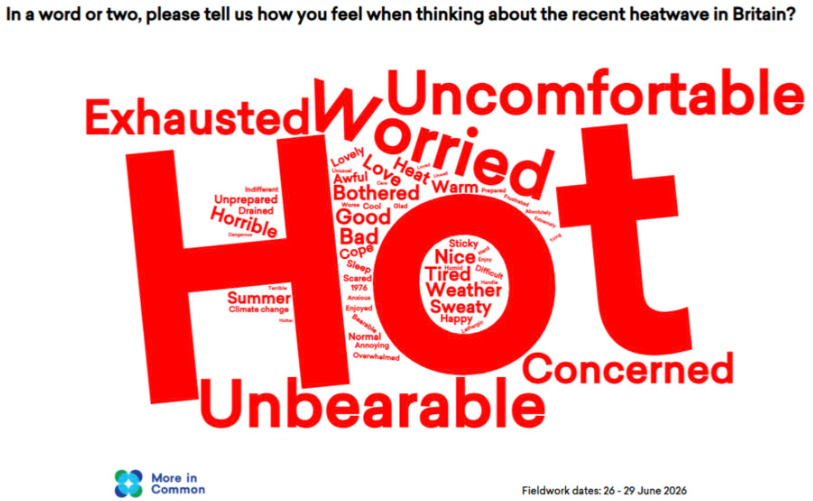
Climate Barometer data points to high levels of worry about the negative impacts climate change will have on nature, poorer communities, and household bills. There is a small/stable minority of people who don’t think the impacts of climate change will be harmful. But the number of people who say they are concerned about the risks of extreme heat has increased significantly over the past decade, and most people think we are not prepared for the risks that climate impacts pose.
Taken together, these measures do not paint a picture of an unconcerned public.
As the Canadian research team behind Re:Climate has argued, issue salience is, primarily, a measure of competition for attention – and there is plenty of competition for our attention.
The idea that people have a ‘finite pool of worry’ has been rightly challenged (climate concern stayed high, for example, throughout the Covid 19 pandemic). But it is certainly possible that people care about more than three issues at the same time (the classic ‘salience’ measure), and that some of these issues feel more immediately pressing than others.
Phases of the transition
The transition towards a decarbonised world and the campaigning required to accelerate it has come in distinct phases.
Initially (among populations fortunate enough to not already be experiencing it), there was a clear objective to raise awareness about climate change and the risks it posed. By educating people about climate change and pushing the issue of climate change up the public and political agenda, governments would be forced to confront the ‘inconvenient truth’ of rising emissions and the problems they created.
The salience of the issue, and awareness (or scepticism) about climate change were the perfect measures to track the progress of this early form of campaigning. Separated-out from the wide variety of other pressing environmental challenges, climate salience became a key indicator of the public mandate for climate action, something it was assumed politicians would find hard to ignore (even if some ignored it anyway).
In countries where the Greens were an established political party, like France, their electoral success could be taken as a proxy of the progress of the climate issue in public opinion.
And in many countries (including France and the UK), climate policies and targets covering transport emissions, clean power and land-use became law. Although they have been subject to contestation and political polarisation, they are indisputably part of contemporary politics.
The era of implementation is well underway, even if progress has been uneven: climate policies and ideas have infused public and political debate. Despite the cold language of ‘co-benefits’, climate policies are persuasive arguments for protecting energy sovereignty (renewables), improving health outcomes (insulation), and alleviating cost of living issues (the electrification of heating systems).
In France, poll after poll tells the same story. Moving past our dependence on fossil fuels is perceived as a question of independence and autonomy, more than a ‘climate’ policy. Getting pesticide free, local food at the canteen is perceived as a health policy, more than an environmental one.
Increasingly, as people interact with and benefit from ‘climate policies’, they may not be thinking about climate change. They may support those policies based on a wider rationale than the urgency of climate change. As such, climate salience might no longer be the go-to indicator to measure progress.
The real risks to the transition
There are genuine risks to progress on climate change – but climate change not leading the list of issues that people report worrying about day-to-day isn’t the most pressing one.
Upfront costs, perceived fairness, the distribution of the benefits of climate policies and trust in the institutions delivering climate policies are all much more significant influences on how the transition unfolds.
As Climate Barometer data shows, what people are weighing up when they consider proposals for energy infrastructure in their local area isn’t primarily their concern for climate change. It is the impact on local communities, and the local environment (or the benefits community ownership can bring).