Heat, Drought & Wildfires

Our latest public opinion data & a new measure of climate opinion

24 September 2026

Here’s how public views have shifted over the summer – and introducing a new ‘health check’ of climate opinion!

Photo: Niall McLoughlin

Earlier today we launched our latest wave of public opinion data.

You can catch up on the recording and download the slides here. Our easily-shareable tracker charts on the Climate Barometer website are all being updated too.

The new data, featured today in Business Green and the Daily Express provides a clear picture of how public views have shifted over a long, sweltering summer, with some striking changes in the salience of environmental risks and a growing recognition of how unprepared the UK is for a changing climate. 

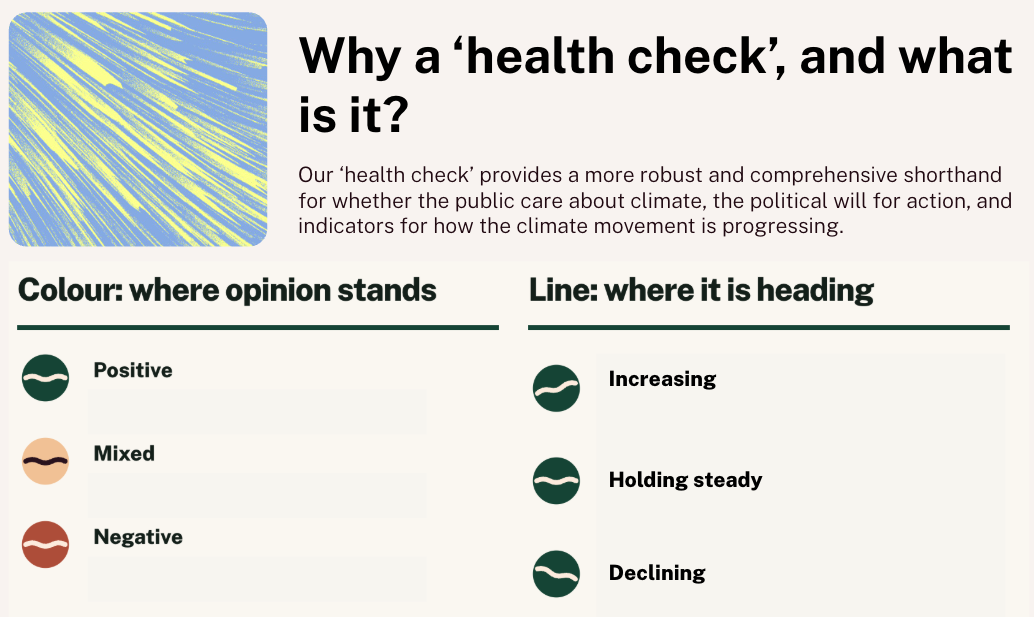
We also trialled a new ‘health check’ feature: a battery of items, designed to provide a better gauge of public opinion than measures like issue salience can, alone.

More on all of this below! But first a couple of quick notes:

  1. This wave marked a shift in data provider (from YouGov to Savanta), so we included additional checks and comparison questions, in order to be as confident as possible in the quality of the data and how to interpret it (also factoring in what wider research is showing – as we always look to do).
  2. This wave was also the first time we’ve included a set of questions co-designed with partners as well as those crowd-sourced from you, our newsletter subscribers – more on this to come – but they mark the start of our ambition to evolve Climate Barometer into an even more shared/partner-driven resource for the climate sector.
  3. We are trialling an accessible way to explore the questions we asked and a simple way to contact us about accessing the data here.
  4. Thanks to our guests Lucas Francou Damesin and Mehri Khosravi who provided their expert perspectives in the webinar – and thanks to everyone who could join us at the event and for such great questions. Anything we didn’t get to in the webinar, we’ll do our best to answer in future newsletters. 

The impacts of a sweltering summer

Over the summer, heat, drought and wildfires overtook flooding as Britain’s top climate concern.

62% of the public now name extreme heat as the most pressing climate impact, up from 36% in October 2024, and public concern that wildfires are ‘pressing’ to deal with has more than tripled over the past two years, from 13% in October 2024 to 47% this summer. Concern about drought and water scarcity as a pressing issue has also nearly doubled, from 26% to 48%.

The shift in lived experience is just as sharp. 

Heatwaves and extreme heat are now by far the most common personal experience of climate impacts in the UK, with three in four people (74%) saying they’ve experienced this – the highest figure in years of tracking, and up from just 46% before this summer began. It marks a jump of more than 30 percentage points since Climate Barometer first asked the question in April 2024, when the figure stood at 43%.

People’s reported experience of wildfires has quadrupled in the same period, from 5% to 20%, now similar to the number of people who have experienced flooding (21%). Just 11% of people say they’ve experienced no climate impacts at all, down from 35% in October 2024.

But whilst 74% of Britons have now experienced extreme heat, only 14% have seen local cooling measures such as tree planting or public shading in their area. 

And this gap in delivery is matched by a deep level of mistrust in government to protect the public from the impact of climate change: nearly half of the public (44%) don’t feel that the government will protect them and their homes from climate events like extreme heat, flooding and storms.

These findings reinforce patterns seen in other polling carried out over the summer, pointing to what may be a genuine step change in UK public opinion on the immediacy of climate impacts.

Issue salience & a ‘health check’ of public engagement

What about wider measures of public engagement? 

Our new ‘health check’ measure is our attempt to concisely capture how public opinion is shifting, that goes beyond a sense of immediate alarm, or a (likely) temporary rise in the salience of climate change as an issue.

We’ve been talking a lot this past year about ‘issue salience’ and whether it is the best or only measure of gauging public opinion on climate change. 

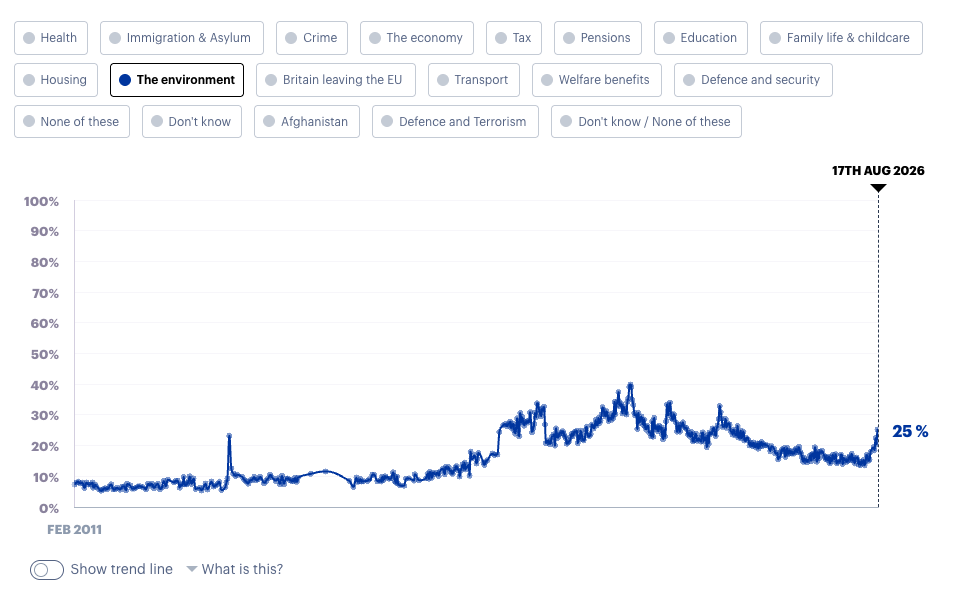
For the public, ‘the environment’ (used interchangeably with ‘climate change’ in many opinion trackers, and arguably capturing a much wider range of issues including worries about nature or wildlife) remains low on the top 10 list, although it has increased over the summer.

Other polling shows a similar (if not larger) jump in salience following the summer (albeit very unevenly across voter groups). Whether ‘the environment’ is a top 10 issue has often been used as a shorthand for:

  • Whether people care about climate change
  • Whether there is political will for climate action
  • How well the climate movement is doing more generally

We think that is a lot to put on a single question. And when trends in other measures of climate opinion offer different or divergent patterns, how do you keep a coherent story together? 

Our ‘health check’ is designed to answer that question. 

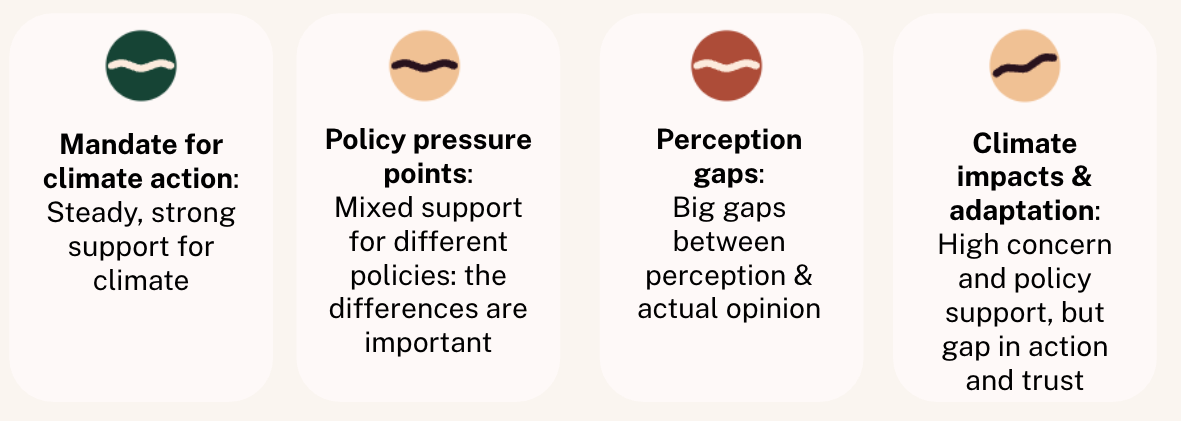
Using this system, we assessed a set of key metrics across our dataset. With this approach, it’s possible to keep a coherent overall story in mind, whilst also paying attention to important differences. 

The overall mandate is strong and support for the government’s net zero target remains steady. More of the public are saying the government should do (or is doing the right amount on climate), and there has been an uptick in views that ‘not taking action on climate change’ will cost too much.

On specific policy pressure points, there are some success stories, but also very low support for key aspects of decarbonisation policy.

On perception gaps, there are still wide perception gaps around what we think other people think about new energy infrastructure. The vast majority of the public would support the construction of a new wind farm, solar park, or renewable energy carrying pylon in their local area. But the majority of people (and their representatives) don’t realise that – overestimating opposition and underestimating support.

On climate impacts & adaptation, we already walked through many of the key findings from this wave at the top of the newsletter –  but support for adaptation policies (in contrast to many mitigation measures) is high and cross-partisan.

Send us your feedback!

We’d love to know what you think of the health check approach. Is it useful for your work? Can we start thinking about a way to talk about public engagement that goes beyond issue salience, uses a set of common measures, and is driven by the needs of the people doing the frontline work?

As always, please get in touch if you’d like to discuss working with us.

The latest from the Heat, Drought & Wildfires timeline:

Wider Context 26th August 2026

40,000 extra people died on England’s hottest days between 1988 and 2025

More than 40,000 extra people died on England’s hottest days between 1988 and 2025 compared with what would be expected in normal temperatures, according to new ONS data.

Deaths from high heat are expected to keep climbing as climate change and an ageing population combine, with older people, children and the unwell most at risk.

The strain has been visible across the health system: A&E departments saw their busiest period on record, with almost 2.5 million attendances a month in May, June and July, with record-breaking heat cited as a key factor. Nurses reported collapsing on shift amid what their union called “inhumane and impossible” conditions.

  • Source: the Guardian
  • Author: The Guardian
  • Date: 26th August 2026
Climate Barometer Tracker 25th August 2026

Experience of heat, drought and wildfires shaped by political worldview

Data from a Climate Barometer & Flooded People survey carried out in March-April 2026 shows how politics plays a clear role in reported experience of heat, drought and wildfires amongst the UK public.

Green (59%), Plaid (55%) and Labour backers (54%) were the most likely to report personal experience of heatwaves/extreme heat, while Liberal Democrats were the most likely to say they have experienced drought and water scarcity (18%).

Plaid Cymru backers were the most likely to highlight an experience of wildfires – even ahead of this summer’s ‘firewave‘, which saw a number of major fires across Wales. They are followed by SNP backers (11%) showing how geography likely plays a role here too.

Yet Reform UK backers are the ones who diverge the most – just 32% report experience of heatwaves and extreme heat – and just 3% say they have experienced wildfires.

Opinion Insight 24th August 2026

YouGov tracker: Uptick in importance of ‘the environment’ amidst a summer of extremes

YouGov’s long-term data tracking shows an uptick in the belief that ‘the environment’ is one of the UK’s most important issues, amidst a summer of unprecedented heat, fires and drought. Although this increase does not match high points across the trend line, or the impact of summer heat episodes between 2022-2024.

The importance Britons placed on ‘the environment’ rose +11% across this summer – from 14% on the 4th May (pre-heatwaves) to a peak of 25% on the 17th of August, before dropping slightly again to 23% on the 24th of August.

These shifts have been particularly noticeable amongst Lib Dem supporters (+17%, from 23% to 40% in the same period), Labour supporters (+15%, from 22% to 37%) and women (+14%, from 15% to 29%).

This data follows a piece by YouGov published after the June summer heatwave, which suggested that the heat had not impacted people’s climate opinions or actions, despite 71% believing the heatwave was likely to have been caused by climate change.

While this certainly appeared true at the time – the latest data suggests this piece may have been premature in catching the full effects of the extreme heat on environmental salience this summer (especially when previous weather extremes have led to spikes in issue salience data).

  • Source: YouGov
  • Author: YouGov
  • Date: 24th August 2026
View Heat, Drought & Wildfires timeline now

Add Feedback