• Overview
  • Feb '26
    What drives support for local energy infrastructure?
  • Varied levels of support for individual net zero policies
  • Jan '26
    Signal in the Noise: Climate opinion trends for 2025/26
  • Dec '25
    Our latest public & MP opinion data
  • Support for net zero is plateauing, not plummeting
  • Public think polluting business and industry should pay for net zero
  • Nov '25
    The Autumn Budget and public opinion – bills, taxes, and more
  • High public support for home insulation
  • The government released its latest public opinion tracker figures
  • Oct '25
    Missing Links: Connecting the ‘how’ and the ‘why’ in net zero engagement
  • Jul '25
    Unions demand green jobs
  • Linking impacts to net zero
  • Barriers to heat pump adoption
  • Climate opinion in ‘Shattered Britain’
  • May '25
    New public polling: Behind the noise on net zero
  • Dec '24
    Signal in the Noise: Trends in the UK climate discourse in 2023/24
  • Nov '24
    If Labour wants to move fast and build things, it’s time to stop the name calling
  • Tracker data: The public and MPs underestimate support for net zero
  • Sep '24
    Polling: Building familiarity with EVs necessary to overcome misconceptions
  • Has support for net zero risen or fallen since the election?
  • Jul '24
    Labour’s plans for Great British Energy brought to parliament
  • What do MPs need to know about voters’ views on climate?
  • New Labour government elected
  • Majority of public feel accepting of local pylons
  • MPs and the public underestimate public support for pylons
  • Why better insights on ethnicity are important for climate communication
  • May '24
    Tracker data: How is support for phasing out petrol and diesel vehicles changing?
  • Apr '24
    Scotland drops 2030 emissions target but retains 2045 net zero ambition
  • Comment: Reform voters and net zero
  • Mar '24
    What the public misunderstands about heat pumps
  • Grantham Institute survey: What benefits do people think climate policies will bring?
  • Spring Budget 2024: A small number of ‘green-tinged’ measures
  • Jan '24
    Survey: Knowing someone with a heat pump increases support
  • Carbon Brief analysis shows record opposition to climate action by right-leaning UK newspapers in 2023
  • Nov '23
    Desmog publishes analysis of ‘anti-green’ Telegraph commentary on net zero
  • Comment: Bumps on the road to net zero in 2023
  • Tracker data: No signs of polarisation around the 2050 net zero target
  • Oct '23
    Public First polling: Delays to net zero make a party less electable
  • Conservatives urged to reconsider anti net zero strategy after Tamworth & Mid Bedfordshire by-elections
  • Scrapping, banning or delaying? Why question wording matters for understanding opinion on net zero
  • Climate Change Committee: Net zero targets are harder to achieve after changes to policies
  • Sep '23
    Onward league table shows which net zero policies are popular among voters
  • More in Common polling: Few Britons want the government to do less to reach net zero
  • Rishi Sunak announces delays to near-term net zero targets
  • Do people think net zero will be expensive, or can the costs fall fairly?
  • Jul '23
    International comparison: UK support for net zero policies
  • Sep '22
    Briefing paper: The road to net zero – UK public preferences for low-carbon lifestyles
Topic

Net Zero

Filter content Please note: The page will automatically update when any filters are changed or set.
  • In Brief

    The UK has legally binding commitments to achieve net-zero emissions by 2050. But in terms of building support for the specifics of the transition, the journey has only just begun.

    Roughly 60% of emissions cuts will need to come through changes to the way that energy is consumed if net-zero targets are to be achieved. This means how people think and feel about the transition to net-zero is central to how fast (and how fairly) the transition takes place. 

    From the phase out of new petrol and diesel cars (and phase in of electric vehicles), to the installation of heat pumps and retrofitting of insulation, reaching net-zero emissions by 2050 requires ongoing public support and a broad political mandate.

    The Climate Change Committee has been clear that the government needs to empower and inform households and communities to make low-carbon choices, and calls for a step-change in government approaches to public engagement reflect the scale of the emissions cuts that must come through people supporting and undertaking shifts in behaviours (e.g. eating less meat) or adopting new technologies (e.g. heat pumps).

    How is opinion on net zero in the UK evolving?

  • Opinion Insight 10th February 2026

    What drives support for local energy infrastructure?

    The government’s newly published Local Power Plan points the country in a direction that the British public support: clean energy that’s transparent, affordable, and delivers real benefits to communities and their local environments.

    When we asked about the three most important factors for involving local communities on infrastructure proposals, both the public and MPs were most likely to select “clear, plain language information about the project and its impacts” and “being asked for views early, before decisions are made”. These were followed by “a clear explanation of how views influenced the final decision” for MPs and “independent or trusted organisations running the process” for the public.

    When we asked which 3 factors people felt were most important in terms of influencing their support or opposition for local infrastructure projects, they picked: the project’s impact on the local environment, on energy bills and on the local community as the top considerations.

    These three priorities are consistently the highest for all groups across age, gender, region, social grade, housing tenure, political support, education level, ethnicity, and whether they live in urban or rural areas; a rare point of alignment between these different subgroups of the public.

    Strikingly, what made much less of a difference were people’s views about climate change and net zero.

    This doesn’t mean that belief in (or concern about) climate change isn’t a critical foundation on which to build engagement around clean energy in general (this is the core idea behind linking the ‘how and the why’ on net zero, as we argued in our recent message testing work with Public First).

    But when it comes to specific clean energy projects, the local impacts and financial considerations loom larger: as the transition becomes ever more place-based, this trend is only likely to accelerate.

    Opinion Insight 5th February 2026

    Varied levels of support for individual net zero policies

    Our tracker shows the enduring popularity of policies that also save on household bills (like installing insulation, or incentives to do so).

    Although Low Traffic Neighbourhoods (LTNs) get a bad rep, our tracker shows support outweighing opposition and support gently rising over the past three years.

    One way to look at levels of policy support across the piece is that they’re really quite stable – but some are not stable in a good way. When it comes to sales of new gas boilers, and the phase out of sales of new petrol and diesel vehicles, opposition started to outpace support around 18 months ago, and this trend has (slowly) continued. 

    Opinion Insight 18th December 2025

    Support for net zero is plateauing, not plummeting

    When, if and how to talk about ‘net zero’ has been on a lot of people’s minds this year.

    Politically, the term has been at the centre of a collapse in the cross-party consensus on climate change. Media hostility has ramped up.

    But despite intensifying campaigns against net zero by opponents of green policies, our tracker shows support for the 2050 net zero target holding steady.  

    Our latest data suggests that public backing for net zero is plateauing rather than plummeting, and support is still more than double opposition. The outliers are Reform supporters, who are disproportionately exposed to anti-net zero rhetoric from Reform politicians and Reform-sympathetic media.

    But while Conservative MPs have largely followed their current leader in turning on the 2050 target, their remaining supporters haven’t.

    Opinion Insight 10th December 2025

    Public think polluting business and industry should pay for net zero

    Climate Barometer tracker polling from October 2025 shows that the public primarily hold ‘businesses that pollute the most’, ‘the fossil fuel industry’, and ‘energy companies’ responsible for covering the majority of costs of transitioning to net zero.

    This is consistent for almost every voter group, with the exception of Reform UK supporters, who are reluctant to single out the fossil fuel industry, and are more likely to say ‘nothing would make net zero fair (22%), and Green party supporters, who are more likely to hold the wealthiest 1% of households responsible.

    Notably, the public do not hold airline companies, the motor vehicle industry, or households who pollute the most – to the same degree of responsibility.

    Opinion Insight 27th November 2025

    High public support for home insulation

    While changes are being made to the Energy Companies Obligation and the Warm Homes Plan, our latest tracker poll shows that the majority (69%) of the public support government incentives for homeowners to improve home insulation. This support carries across voting lines, with even supporters of Reform, who are typically the least supportive of climate related policies, indicating majority approval (56% support).

    The majority of the public are also supportive of financial support to low income families for green home upgrades. Not only is this a crucial aspect needed for a fair transition to clean energy, the relative consensus among the public is a rare opportunity.

    Opinion Insight 13th November 2025

    The government released its latest public opinion tracker figures

    The number of people who agree ‘there is no such thing as climate change’ remains marginal: only 2% agreed with this statement in the latest opinion tracker from the Department for Energy Security and Net Zero.

    It’s important – in a period of political instability and the fracturing of the climate consensus – to remind ourselves that despite the turbulence, outright denial of climate change is almost non-existent.

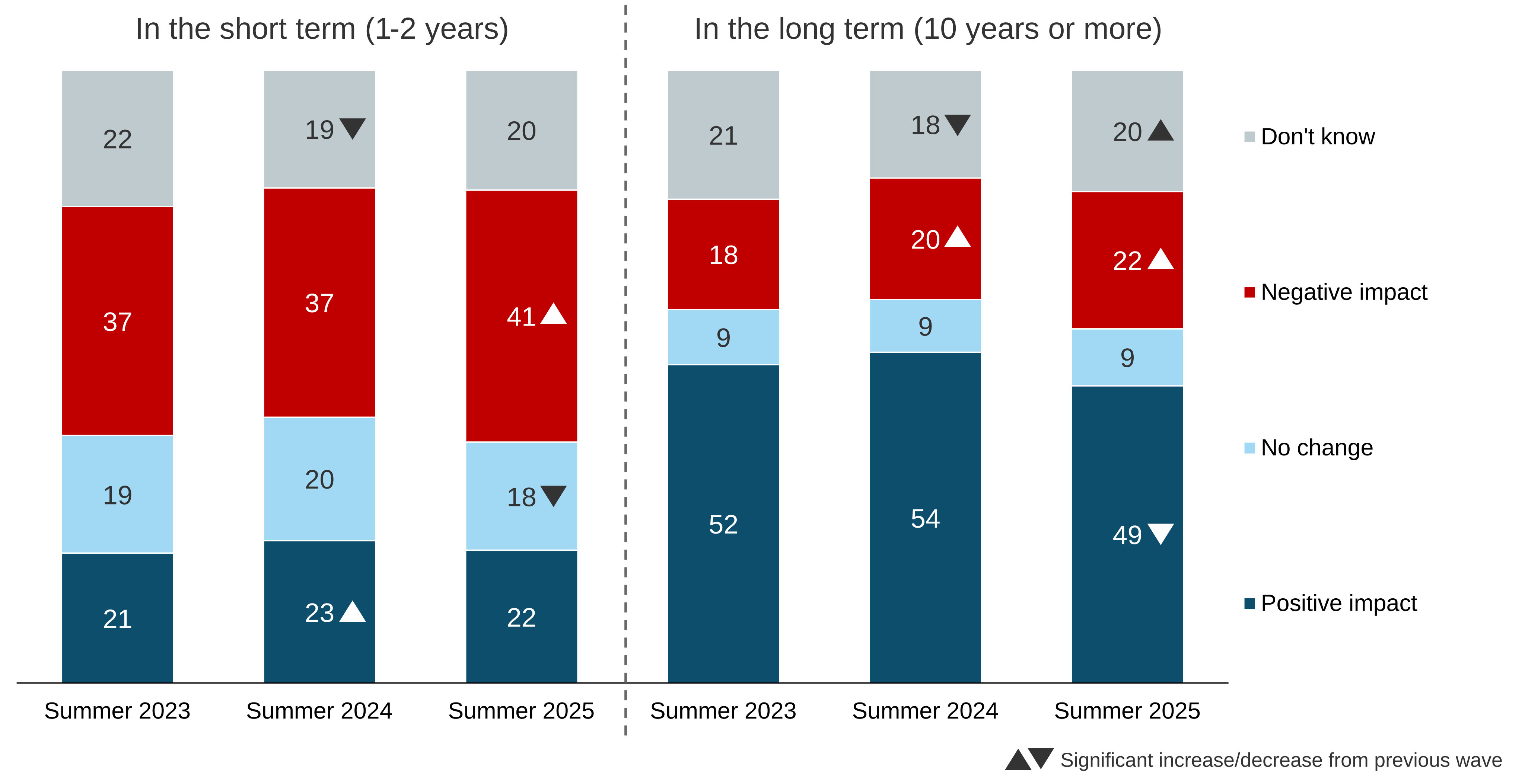
    And most people (49% vs 22%) recognise that the energy transition will be positive for the country in the long-term.

    But (backing up a signal that is getting louder by the day) the DESNZ data shows that concerns about the costs of green policies are growing, with a record high of people who think the economic consequences of the country’s transition to Net Zero will be negative in the short-term.

    Labour has promised to reduce energy bills by £300 a year, and (long-term) the policies being introduced will likely deliver this. But short-term, the financial insecurities that people face (which have little to do with green policies) are being weaponised by opponents of climate action.

    Whilst this happens, making the best case for what is currently on the table is equally critical: this requires connecting the ‘how’ and the ‘why’ of net zero alongside telling people’s stories to demonstrate that the transition is both achievable and effective. Read more about the takeaways from Climate Barometer & Public First’s recent net zero message testing research here. 

    Opinion Insight 29th July 2025

    Unions demand green jobs

    Two major trade unions, GMB and Prospect, have launched a new campaign ‘Climate Jobs UK’, warning that public support for the net zero transition could weaken without faster progress on ‘green’ job creation.

    The unions, which represent tens of thousands of energy workers, say people need to see good jobs where they live or risk being drawn to parties that are opposing climate action.

    New polling commissioned for the campaign shows that while most people back the energy transition, more than half (55%) want jobs and the economy prioritised over speed (17%). Only 30% believe the transition will improve UK job opportunities and fewer than 1 in 10 say they’ve seen green jobs in their area.

    Expectations for positive impacts of net zero policies on job opportunities in local areas are in fact low. As recent Climate Barometer data shows, only 1 in 5 Brits anticipate net zero policies to have a positive impact on the local job market over the next five years, with the most common responses being ‘don’t know’ or net zero policies having ‘no impact’.

    As this data shows, the British public doesn’t anticipate net zero policies to impact them negatively, but they also won’t go out of their way to defend something that feels abstract and irrelevant to their everyday lives.

    Whilst younger age groups tend to think the impact of net zero policies on jobs will be more positive, these findings underline the importance of climate action being felt to tangibly improve people’s lives. This will require people seeing their neighbours, friends or family in good jobs that can provide some stability for the future — and which are, by default, ‘green’.

    Opinion Insight 29th July 2025

    Linking impacts to net zero

    The link between climate impacts and net zero isn’t always easy to explain, but it matters. We need to cut emissions to limit the worst effects of climate change. But for many people, the link between net zero and real-world impacts like extreme heat or flooding can feel abstract or distant. So how can we make the link?

    As part of his first annual climate statement to Parliament, Miliband warned that the climate crisis cannot be ignored. He called out politicians rejecting net zero as “betraying future generations” and said the shared commitment to tackling climate change “must not disappear by default”.

    Climate action as a way of staying true to future generations echoes the public’s view on why tackling climate change matters. As Climate Barometer data shows, when asked what they thought were the most convincing arguments for pursuing net zero, Britons were most likely to select the idea that “We owe it to our children and grandchildren to take action to reduce our emissions now; otherwise it is they who will suffer the most” (35%).

    This focus on protecting future generations also aligns with what makes climate change feel most urgent to people. New research shows that presenting climate impacts in binary terms is more effective in making it seem more real and imminent than showing average trend data. As extreme weather events gradually become more frequent and severe due to climate change, people tend to become accustomed to the new normal, also called the ‘boiling frog’ effect, and struggle to identify abnormal weather patterns over time.

    Presenting climate change in binary terms helps to overcome that. In the study, people found a graph showing whether a fictional lake froze each winter more impactful than a chart of rising average temperatures in a fictional town. This research highlights how important it is to use clear before-and-after examples when talking about climate impacts.

    Alongside message testing which suggests it’s helpful to frame climate impacts as “unnatural disasters” while making clear links to policies, these insights could help make climate communication resonate with the British public’s real and sustained concerns.

    Opinion Insight 29th July 2025

    Barriers to heat pump adoption

    With roughly 360,000 heat pumps currently installed across the UK, the country remains a long way off the government’s target of installing 600,000 heat pumps every year by 2028, as laid out in the Energy Security Bill. But where do people currently stand on their journey toward using heat pumps? What barriers are holding back wider adoption, and how do these challenges vary across society? Most importantly, what can be done to overcome them?

    Nesta’s new audience research helps to answer these questions by providing a segmentation of UK households based on demographic data, their housing situation and attitudes towards heat pumps. Ranging from “eco, high-earning Gen x-ers” — of whom 3% say they already have a heat pump — to “social tenants on tight budgets”, the report identifies the biggest heat pump enablers and barriers for each group to help them adopt the new technology.

    And help is urgently needed: As Climate Barometer data shows, public knowledge of heat pumps remains limited, with only 37% of Britons knowing what a heat pump looks like, 22% saying they can describe how a heat pump works, and just 17% having heard mostly good things about them. Alongside this, 1 in 5 Britons have heard and agree with the statement that “heating technologies to replace gas boilers are untested and unreliable”, compared to only 1 in 10 who have heard the argument and disagree with it.

    But for heat pumps to become a widely adopted source of heating over the next couple of decades in the UK, it will require more than fixing their image problems. Those who would already consider switching to a heat pump need to be supported to do so practically, and those who are currently unable to or hesitant about installing them need safe assurances that heat pumps will actually improve their comfort and help lower their energy bills over time.

    Opinion Insight 14th July 2025

    Climate opinion in ‘Shattered Britain’

    More in Common’s new Shattered Britain report details climate opinion in the context of changing views across the nation.

    The report shows that despite clear dividing lines in their broad worldviews, 6 out of 7 UK segments are ‘more worried than not’ about climate change – and believe the government is ‘not doing enough’ to tackle the crisis. 

    Whilst only 21% of the public opposed the 2050 net zero target, views on whether net zero Britain should be achieved by means of a strict target are far more varied, with only Progressive Activists clearly speaking out on its behalf. The piece also finds a decoupling of net zero and climate support across segments.

    This echoes Climate Barometer data about government action on climate change, and the growing disconnect between net zero and climate opinion.

    • Author: More In Common
    • Date: 14th July 2025
Loading more posts...

Add Feedback