• Overview
  • Aug '26
    YouGov poll: Few want another heatwave, except Reform voters.
  • Public strongly back maximum workplace temperature
  • As climate impacts intensify, who should pay for the costs?
  • Poll: Extreme heat is disrupting work, exercise and sleep.
  • Driest July in nearly 200 years, Met Office says
  • How do the public engage with climate ‘adaptation’ in 2026?
  • Jul '26
    Record wildfire season hits UK and Europe
  • England on track this year for the highest number of heat-related deaths
  • Heat is making Brits more fearful of the future
  • Climate coverage hit a high in 2026 due to heatwaves
  • Child heatwave exposure in the UK already at record levels for 2026, as drownings spike
  • Stories of extreme weather and local community action across the UK
  • The Birmingham school making changes to cope with heat
  • ‘Climate’ mostly absent from national media coverage of record-breaking June heatwave
  • Britons blame climate change for June 2026 heatwave
  • Parents concerned for children’s safety during UK heatwaves
  • Poll: People’s sleep and health being impacted by extreme heat
  • Jun '26
    How a local business in Birmingham is adapting to extreme heat
  • Britons view climate preparedness as an urgent, top priority
  • May '26
    The Welsh farmers tackling wildfires
  • The public want urgent action on floods, heat, and droughts
  • CCC: British way of life is under threat from heat, flooding and drought
  • Public believe climate risks are becoming more frequent and severe
  • Apr '26
    Behavioural responses influenced by heat alert severity
  • Mar '26
    Heat resilience policies widely supported as majority continue to think UK is unprepared
  • Sep '25
    2025 is UK’s hottest summer on record
  • Jul '25
    Miliband’s ‘State of the UK’ address on climate impacts
  • To help people prepare for extreme heat, we must communicate better
  • Jan '25
    Majority think UK is not prepared for climate impacts
  • Nov '24
    Unprecedented 2022 heatwave was experienced unevenly
  • Oct '24
    Growing calls for a ‘climate resilient net zero’
  • Sep '24
    Almost half of Britons have personally experienced heat waves
  • Jul '24
    More focus needed on ethnicity and climate impacts link
  • Feb '24
    Decision makers don’t feel prepared for further heat events like the summer of 2022
  • Nov '23
    Making sense of public opinion on climate impacts
  • Oct '23
    Report: How people of colour experience climate change in Britain
  • Sep '23
    Climate Change Committee: How to help the UK public prepare for climate impacts
  • Summer 2023 was the hottest on record globally
  • Apr '23
    Tracker data: Gender divide in MPs’ beliefs about cost of climate impacts
  • Jan '23
    What shapes people’s engagement with heat risks?
  • Oct '22
    Research paper: Media portrayal of heatwaves undermines the seriousness of heat risks
  • Aug '22
    ACT Climate Labs: How to combat misinformation around extreme weather
  • Jul '22
    UK experiences temperatures above 40°C for the first time
  • Mar '20
    Cardiff University polling: concern about heat risks has increased over the past decade but floods still top the risk table
  • Nov '19
    Report: Vulnerable people don’t feel they are at risk from heat
Topic

Heat, Drought & Wildfires

Filter content Please note: The page will automatically update when any filters are changed or set.
  • The Latest

    As Europe warms twice as fast as any other continent, heat risks in the UK are intensifying at an alarming rate. More than 10,000 heat-related deaths have occurred between 2020 and 2024. The summer of 2026 – with more than five heatwaves, an unprecedented ‘firewave’, and an ‘exceptionally serious’ drought – saw close to 3,000 heat-related deaths in May and June alone.

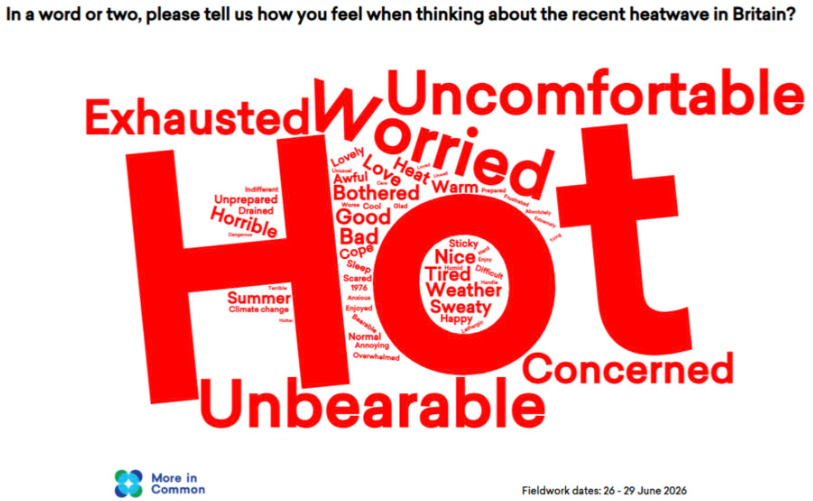
    In this context, heat has become the most commonly reported climate impact in the UK. This topic thread highlights how it is now making Britons more fearful of the future, parents scared for their children’s safety, and is disrupting the nation’s health, sleep and work. 

    Heat risks aren’t felt equally. The data increasingly reveals how heat, drought and fires are experienced differently due to politics, region, income and ethnicity. And at the local level people are facing up to heat, drought and fires in different ways: from Welsh farmers embracing nature-friendly approaches, to Birmingham schools and restaurants adapting to the heat.

    But despite community actions, the nation has repeatedly warned that we are not prepared. This widespread sentiment underpins why people want climate risks to be taken much more seriously – with urgent action to build resilience seen as a ‘top priority’.

    In practice, this translates into support for maximum working temperatures, more greenspace, better regulations, and solid plans put in place for when heat, drought and fires hit. With the affordability of many measures remaining front and centre – rather than the burden falling to those worst affected, the public will be looking to the government and the worst polluters to step up.

    This thread was developed with input from the Centre for Climate Change and Social Transformations (CAST), Local Storytelling Exchange, and Climate Outreach.

  • Opinion Insight 7th July 2026

    Poll: People’s sleep and health being impacted by extreme heat

    Polling by YouGov for Greenpeace has shed light on how people’s sleep, health, and work were disrupted by June’s heatwave across the UK:

    • 65% of UK adults struggled to sleep during the heatwave, with nearly half (48%) of those losing three or more hours sleep each night
    • Just under a quarter (23%) said they or someone in their household felt physically unwell because of the heatwave
    • 60% of workers said their workplaces were uncomfortably hot
    • More than a quarter of workers (27%) admitted they were less productive, and 9% reporting they worked in unsafe conditions

    There was clear support when it comes to improving heat policies and structural measures:

    ● Over half of respondents (56%) said their homes need retrofit upgrades to cope with future heatwaves – yet 78% would struggle to afford them.

    ● Almost half (46%) of UK adults said they would support a levy on high-carbon emitting companies to fund these essential upgrades.

    ● 22% of UK adults were forced to throw away food that spoiled in the heat, went off sooner than expected or couldn’t be kept cool – compounding cost-of-living pressures.

    Local Insights 24th June 2026

    How a local business in Birmingham is adapting to extreme heat

    Amidst ‘red’ level heat warnings, a dim sum restaurant in Birmingham’s Chinatown has made significant changes to ensure it can stay open, and it’s workers stay cool. This includes replacing fridges, installing fans, as well as providing water and cool spaces so staff don’t overheat. The story covered by Channel 4 News was made possible by the work of Local Storytelling Exchange.

    Opinion Insight 15th June 2026

    Britons view climate preparedness as an urgent, top priority

    New survey data shows that nearly three quarters (71%) believe the government should make adapting to climate risks like floods, heat, and droughts an “urgent, top priority”, while only a minority (15%) disagreed.

    The findings, from a nationally representative UK survey in collaboration with Flooded People, highlight the public desire for action on impacts like floods, storms, heat and drought.

    While experts in the climate sector separate out ‘adaptation’ and ‘mitigation’, our new data shows that a majority (55%) think these two broad responses should be prioritised equally (echoing our previous tracker insights).

    The survey also showed that most people report one or more direct experience of climate impacts. Heatwaves and extreme heat are the most commonly experienced climate impact (felt by 46%). A third have experienced ‘severe storms’ (30%), and a fifth say they have been directly affected either by flooding or poor air quality (both 21%). It’s less than a third (29%) who still say they have “no experience of impacts” at all.

    Local Insights 24th May 2026

    The Welsh farmers tackling wildfires

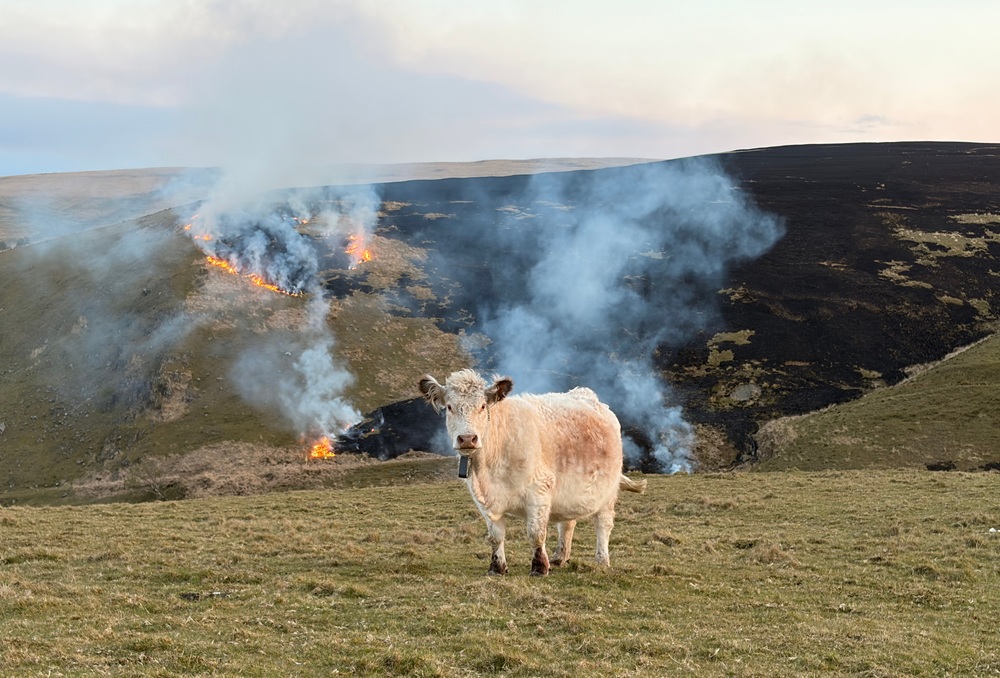
    Welsh farmers are showing how nature-based approaches can help prevent the spread of wildfires. In Elan Valley, farmer Sorcha Lewis watched a wildfire descend from the uplands to the back of her house. But amidst the devastation, one piece of land stayed untouched: a section of peatland that had recently been re-wetted. This story, which offers insights into positive ways forward for upland farming, was published widely – including on Nation Cymru (see here for a video by Local Storytelling Exchange). This echoes other stories of fire-sensitive farming in Wales, such as the ‘cow firefighters’ who keeping the Gower common safe from wildfires (see ITV Wales coverage here).

    Photo credit: Sorcha Lewis

    Policy Insight 20th May 2026

    CCC: British way of life is under threat from heat, flooding and drought

    The Climate Change Committee published its latest stock take of climate preparedness, painting a stark picture of floods, heat risks and possible water shortages in the UK – while emphasising how much can still be done to support, protect and prepare communities.

    ‘A Well-Adapted UK’ highlights that 92% of the country’s homes are likely to ‘overheat’ by the middle of the century – while peak river floods could be 45% higher, and water shortfalls could exceed five billion litres per day. Inaction could cost anywhere between £60-£260 billion per year.

    A citizens’ panel, published alongside this report, found that people people want to see adaptation happening now and for it to be done ‘properly’, with long-lasting preventative solutions that limit harm to no more than what is already being experienced.

    The stocktake points towards a range of key policy measures needed to improve UK resilience to rising climate impacts, including:

    • Greater investment in cooling – including air conditioning, heat pumps and green shading – across key public services, alongside  national maximum temperature for workplaces to protect workers’ safety.
    • Increasing flood risk investment to around £1.6–£2.2 billion each year across the UK to prevent risks increasing further, and avoiding new construction where flood risks are not adequately reduced.
    • Taking substantial actions now to avoid water shortages, such as a strong regulatory focus on drought, scaling up sustainable water storage, accelerating leakage reduction and cutting water demand.
    Opinion Insight 18th May 2026

    Public believe climate risks are becoming more frequent and severe

    New data from Public First shows that the public believe that climate risks –  are becoming more frequent and severe. Nine in ten (87%) expecting the UK to be impacted again in the next five years.

    The public feel the UK is least prepared for flooding (70% said not prepared), closely followed by heatwaves (68%). Dry spells and drought (66%), wind storms (66%), and cold snaps (57%) were also seen as areas of unpreparedness.

    Most believe that better planning could reduce the severity of weather impacts, but many are not sure what that looks like in practice. When asked directly, a majority (60%) say it is ‘possible’ to reduce the effect of climate impacts, but they are uncertain of how.

    • Source: Public First
    • Author: Amy Norman
    • Date: 18th May 2026
    Opinion Insight 11th April 2026

    Behavioural responses influenced by heat alert severity

    A new study has examined how adults in England respond to extreme heat and heat-health alerts.

    The researchers carried nationally representative online survey in August 2025, finding that not all UK heat experiences are equal, and that heat health alerts do not straightforwardly lead to behavioural changes.

    • Nearly one-third of respondents (30%) reported not encountering heat-health alerts at all – this was particularly the case among older adults, low-income groups, and those with limited education.
    • Although willingness to adapt during heatwaves was high (91%), just 41% reported taking protective action when heat-health alerts were issued – a clear ‘intention-behaviour gap’.
    • Amongst those who recalled seeing alerts (69.7%), less than two-thirds (59.3%) took action.
    • Yet the alerts did influence action: Behavioural responses increase with alert alert severity, with 72% following red alerts compared with 25% for yellow alerts.

    Looking deeper into what beliefs influenced responses, the researchers found that people’s behaviour was associated with a sense of the heatwave severity, the possible benefits of acting, a sense of barriers in the way, and their confidence in carrying out actions (self-efficacy).

    • Source: Energy Research & Social Science
    • Authors: Angela Afua Assan, Fatemeh Khosravi, Gloria Osei
    • Date: 11th April 2026
    Opinion Insight 16th March 2026

    Heat resilience policies widely supported as majority continue to think UK is unprepared

    Polling by IPPR and Persuasion UK has highlighted high levels of net support for heat and flood adaptation policies in the UK. The policies receiving the highest net support were:

    • Increasing green space to reduce temperatures, increase flood drainage, and slow water flow, even if that means significantly less space for new buildings or homes (+76% net support)
    • Strengthen regulations so that building and homes are prepared for heat or flooding, even if that slows down building/makes it more expensive (+69%)
    • Make it compulsory for every business to have a plan to respond to extreme heat in the workplace, even if it costs time or money for them to implement (+60%)

    The poll also found that 81% of people feel the UK is unprepared for the worst impacts of climate change, although 59% of people think it’s not yet too late to avoid the worst impacts.

    When it comes to climate adaptation vs. reducing emissions, just  5% of people say they would prioritise adaptation alone.

    This builds on previous polling by Climate Barometer showing that the majority of people feel the UK is not well prepared for climate impacts, and most feel climate adaptation is equally important alongside the shift to clean energy.

    • Authors: Sam Alvis, Sofie Jenkinson
    • Date: 16th March 2026
    Wider Context 4th September 2025

    2025 is UK’s hottest summer on record

    Following months of sweltering heatwaves, record-breaking wildfires and five regions in drought, this week it was provisionally confirmed that 2025 was the UK’s hottest summer on record.

    While this new record  was made ‘70 times’ more likely by climate change, the overwhelming sentiment is that the country is not prepared for more summers like this. The UK’s official climate advisors, practitioners who work on the frontline of the heatwave response, and the British public all agree that the UK isn’t ready for more extreme weather,worsening heat, and compounding risks like water scarcity and wildfires.

    At the same time, there are important perception gaps to address. Despite the alarming statistics about heat-related deaths in the UK, many people were looking forward to the first heatwaves this summer. Lots think that heatwaves will only become a problem for the UK in the future. And many believe that hot weather poses more of a risk to other people, not themselves.

    In this context there are important conversations now happening about how to grapple with the growing climate risks in the UK, including the sudden lurch towards air conditioning (despite its potential to make heat risks worse).

    For more on the key issues surrounding heat communication, check out our recent opinion piece in Climate Home News.

    Opinion Insight 29th July 2025

    Miliband’s ‘State of the UK’ address on climate impacts

    As the UK’s third summer heatwave drew to a close, Ed Miliband used his first annual climate statement to Parliament to warn of the growing impacts of climate breakdown in the UK, backed by the Met Office’s latest State of the UK Climate report.

    The report shows how extreme weather is now the norm in the UK, with data from hundreds of weather stations revealing that the hottest days are becoming more frequent and severe, and intense rainfall has increased.

    • Source: UK Parliament
    • Author: UK Parliament
    • Date: 14th July 2025
    From the Climate Community 14th July 2025

    To help people prepare for extreme heat, we must communicate better

    In this opinion piece for Climate Home News, Climate Barometer’s Niall McLoughlin highlights the urgent need for better communication around extreme heat.

    Despite improvements to heat warnings, a disjointed landscape of heat communications means that many people feel the UK is poorly prepared for heat risks. Niall’s piece calls for improvements such as using social research to better tailor communication, focusing more on longer-term heat preparedness, and closing perception gaps which may lead people to underestimate risks.

    He points also to locally-led tree planting projects as an example of the kind of long-term, community-based preparation needed. Research from Cardiff University has shown that such efforts must be accelerated significantly to help cities adapt to intensifying heatwaves. Their new findings reveal that urban tree planting can cut city temperatures by up to 5°C, making it one of the most effective tools for cooling overheated streets.

    • Source: Climate Home News
    • Author: Niall McLoughlin
    • Date: 14th July 2025
    Climate Barometer Tracker 21st January 2025

    Majority think UK is not prepared for climate impacts

    An overwhelming majority of the public think the UK is not well prepared to deal with climate change impacts and extreme weather, such as flooding, storms and droughts.

    The latest Climate Barometer tracker data shows that only 16% agreed with the statement that “The UK is making good progress in terms of adapting to the risks posed by climate change impacts”, while 39% disagreed.

    More than two thirds (68%) believed that flooding was “the most pressing to deal with in the UK”. This was followed by concerns about sea level rising and coastal erosion; loss of species, habitats and threats of extinction (both 45%); and severe storms (44%).

    Policy Insight 24th October 2024

    Growing calls for a ‘climate resilient net zero’

    In the face of rising climate impacts, UK-based researchers are calling for more measures that simultaneously tackle the root causes of climate change, while enabling society to adapt.

    Efforts to tackle climate change have tended to prioritise mitigation (reducing emissions) over adaptation efforts (reducing vulnerabilities), and these two broad types of measures are often split across government departments, such as Defra and DESNZ in the UK. 

    But new research, using the UK’s record-breaking 40C heatwave in 2022 as a case study, has found clear demands for national and local governments to roll out measures that combine mitigation and adaptation.

    Policy-makers, climate organisations, and those working in emergency response felt that approaches – such as creating climate-resilient neighbourhoods, tree-planting and other nature-based solutions – should be a priority, given their dual benefits. They felt efforts to combine emissions reductions and adaptation have challenges, but were feasible, with better coordination.

    The new analysis also suggests that framing these efforts as part of working towards a ‘climate resilient net zero’ can be a useful way of engaging a range of relevant audiences and decision-makers – building on existing support for net zero.

    The study findings are supported by Climate Barometer tracker insights, which shows that both the public and MPs feel mitigation and adaptation are equally important. It also echoes previous work which found that the public view mitigation and adaptation as “two sides of the same coin”.

    • Source: Grantham Research Institute on climate change and the environment
    • Authors: Candice Howarth, Niall McLoughlin, Ellie Murtagh, Andrew P. Kythreotis, James Porter
    • Date: 21st October 2024
    Climate Barometer Tracker 18th September 2024

    Almost half of Britons have personally experienced heat waves

    When asked about their personal experiences of climate impacts, large proportions of the public have experienced heat waves, extreme heat, storms, and flooding. Of these, heat is the most commonly experienced climate impact, with almost half of Britons surveyed saying they had personally experienced it.

    Only 28% of people surveyed in the Climate Barometer Tracker in April 2024 said that they ‘have never experienced any of these climate events’.

Loading more posts...

Add Feedback