  • Overview
  • Nov '25
    Division is growing – which makes communication on climate change more difficult
  • Oct '25
    Tracker data: MPs continue to underestimate public support for NZ target
  • Sep '25
    2025 is UK’s hottest summer on record
  • Jul '25
    A climate of silence in the UK?
  • Tracker data: MPs and the public continue to underestimate local backing for wind, solar and pylons
  • May '25
    Perception gaps on extreme heat
  • Nov '24
    Tracker data: The public and MPs underestimate support for net zero
  • Tracker data: Huge perception gap on support for onshore wind
  • Jul '24
    Post-election polling shows ‘backtracking’ on net zero targets cost the Conservatives votes
  • Tracker data: Narratives that cut through
  • MPs and the public underestimate public support for pylons
  • Jun '24
    Conservative Environment Network: Polling shows climate change is not salient for Reform voters
  • Trust & influence: Beyond ‘trusted messengers’
  • May '24
    Ipsos global data shows elevated climate ‘apathy’ among younger men
  • Mar '24
    What the public misunderstands about heat pumps
  • What are perception gaps and why do they matter?
  • Feb '24
    Video: People want climate action so why don’t politicians get it?
  • Redfield & Wilton polling: Labour & Conservative voters think climate change not being taken seriously enough
  • Global study shows climate perception gaps are prevalent around the world
  • Jan '24
    Report finds a rise in ‘new denial’ narratives on Youtube and a third of UK teenagers agreeing that climate change is exaggerated
  • Carbon Brief analysis shows record opposition to climate action by right-leaning UK newspapers in 2023
  • Nov '23
    Tracker data: Public oppose fracking, but it continues to polarise MPs
  • Tracker data: MP and public views on energy sources
  • Tracker data: Public support for low traffic neighbourhoods is higher than MPs’
  • Tracker data: No signs of polarisation around the 2050 net zero target
  • Tracker data: Public and MPs underestimate net zero support
  • Oct '23
    More in Common: Labour can increase support among key Red Wall ‘Loyal Nationals’ by focusing on green investment
  • Tracker data: Do MPs see Net Zero as a vote winner or loser in Red and Blue Wall seats?
  • Making sense of differences between the public and MP opinions on oil and gas
  • MPs continue to underestimate importance of the environment for voters
  • Climate Citizens report: MPs underestimate the importance of the environment for voters
  • Making sense of UK polarisation on climate change
  • Comment: What do the Tamworth and Mid Bedfordshire by-elections tell us about support for climate policies?
  • Tracker data: Gap in perceived support for local wind and solar
  • Sep '23
    Onward research: How to build support for net zero policies among Conservative voters
  • Public First: Sunak’s Net Zero speech may scarcely cut through to voters
  • Comment: Polling makes misleading claims about support for clean air zones and net zero
  • Apr '23
    More in Common: Britain’s ‘quiet majority’ want less talk and more action on green energy
  • Sep '22
    More in Common research shows how to engage ‘Blue Wall pragmatists’ on climate change
  • Jul '22
    New research paper: politicians and activists ‘speak a different language’ on climate change
  • Carbon Brief: How UK newspapers changed their minds about climate change
  • Oct '20
    Britain Talks Climate: climate change concerns us all, regardless of income, background or politics
  • May '19
    Poll reveals MP misperceptions over onshore wind
Topic

Perception Gaps & Polarisation

Filter content Please note: The page will automatically update when any filters are changed or set.
    Opinion Insight 13th November 2025

    Division is growing – which makes communication on climate change more difficult

    Climate change didn’t cause the culture wars, but culture wars are making climate change harder to solve.

    In new research from Kings College London (KCL), divisions over climate change are seen as worse than divisions over Brexit, with the public more likely to say there is tension between climate change sceptics and believers (64%) than between Leavers and Remainers (52%), or between younger and older generations (45%).

    This is despite the broad-based consensus on the importance of the issue that Climate Barometer data evidences, and which is seen consistently in wider research (e.g. the recent Britain Talks Climate & Nature report, which highlights widespread care for nature, wildlife and the benefits that the transition to clean, renewable energy can bring).

    More new research (from Hope Not Hate) diving into the differences between people who intend to vote Reform highlights climate change as one of the dividing lines among a disjointed coalition of factions. ‘Squeezed Stewards’ (in an echo of More in Common’s ‘Rooted Patriots’ segment, who have high levels of threat perception around environmental risks) care about nature and acknowledge the climate crisis. But the ‘Hardline Conservatives’ subgroup of Reform backers are much more likely to be in the minority of people who reject action on climate change entirely.

    Climate Barometer Tracker 25th October 2025

    Tracker data: MPs continue to underestimate public support for NZ target

    Both Labour and Conservative MPs continue to underestimate the majority support there is for the UK’s declared net zero target. When asked what proportion of the UK public they believe SUPPORTS (either strongly or somewhat) the UK’s current plan to achieve Net Zero greenhouse gas emissions by 2050, MPs’ estimates averaged at 56%, well below the  63% of the public who actually support the target.

    Looking beyond the mean of responses, Conservative MPs were found to be more likely to underestimate public support for the target than Labour MPs. 13% of Conservative MPs provided an estimated public support figure in the correct range of 61-70%, compared to 22% of Labour MPs whose response fell into that bracket of actual public support.

    Wider Context 4th September 2025

    2025 is UK’s hottest summer on record

    Following months of sweltering heatwaves, record-breaking wildfires and five regions in drought, this week it was provisionally confirmed that 2025 was the UK’s hottest summer on record.

    While this new record  was made ‘70 times’ more likely by climate change, the overwhelming sentiment is that the country is not prepared for more summers like this. The UK’s official climate advisors, practitioners who work on the frontline of the heatwave response, and the British public all agree that the UK isn’t ready for more extreme weather,worsening heat, and compounding risks like water scarcity and wildfires.

    At the same time, there are important perception gaps to address. Despite the alarming statistics about heat-related deaths in the UK, many people were looking forward to the first heatwaves this summer. Lots think that heatwaves will only become a problem for the UK in the future. And many believe that hot weather poses more of a risk to other people, not themselves.

    In this context there are important conversations now happening about how to grapple with the growing climate risks in the UK, including the sudden lurch towards air conditioning (despite its potential to make heat risks worse).

    For more on the key issues surrounding heat communication, check out our recent opinion piece in Climate Home News.

    Climate Barometer Tracker 17th July 2025

    Tracker data: MPs and the public continue to underestimate local backing for wind, solar and pylons

    More than 3 in 5 Brits support local renewable energy infrastructure projects, but neither MPs nor the public realise how strong that support is, new Climate Barometer polling shows.

    There is high in-principle support for a new onshore wind farm (69%), a new solar energy park (73%), and new pylons and power lines for carrying renewable energy (60%), even as those are proposed to be built in people’s local area.

    Whilst support for these renewable energy infrastructure projects has remained largely stable since 2022/2023, perception gaps both from the public when it comes to other people in their area and MPs in terms of their constituents do not seem to have reduced over time

    Moreover, across each renewable project polled, MPs are even more likely to overestimate local opposition than the general public, suggesting that community views are not adequately represented in local discussions.

    Opinion Insight 21st May 2025

    Perception gaps on extreme heat

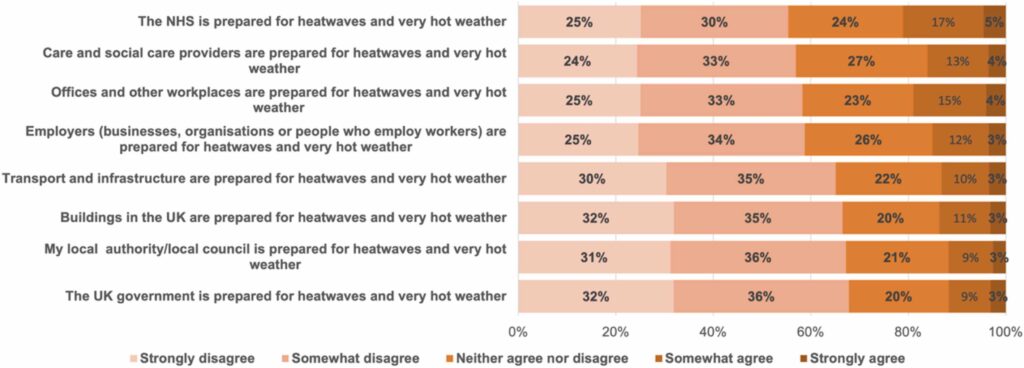
    A research paper – based on a nationally representative survey of 1750 UK residents in summer 2023 – finds several gaps and contradictions in heat perceptions. This includes:

    • Threat-preparedness gaps: While heat was viewed as life-threatening by most (75%) and two-thirds (66 %) believe they are becoming more extreme due to climate change – a majority feel that both national (68%) and local (67%) governments in the UK are not prepared for heat risks, and a similar number (65-67%) did not feel that transport, infrastructure and buildings were prepared.
    • Vulnerability gaps: People tend to see themselves as less vulnerable than others with only 19% saying they feel it is very or extremely likely their own health will be impacted by heat events in the next five years – compared to 29-30% thinking this of their local community or social network. This is striking given 37% say they have personally experienced health-related impacts of heat, while more than half (58 %) say they have experienced discomfort during heatwaves and very hot weather.
    • Mitigation-adaptation gaps: While almost two-thirds (62 %) felt that any government action on cooling must not make climate change worse, and half (55 %) feel green/renewable energy should be used to power cooling measures, there was also strong support for the use of air conditioning. 59% supported AC use with a mix of attitudes on it’s environmental impact (38 % believed it was okay if it leads to an increase in energy use, 37 % were not sure, and 36 % see it as harmful).
    • Authors: Candice Howarth, Heidi Zamzow, Niall McLoughlin, Ganga Shreedhar
    • Date: 21st May 2025
    Climate Barometer Tracker 5th November 2024

    Tracker data: The public and MPs underestimate support for net zero

    Climate Barometer tracker data shows that net zero support is underestimated by, within and between the public and MPs. 

    The actual level of net zero support amongst the public was 65% from our polling in October 2024. But when we asked people to estimate this, most members of the public (70%) and half of MPs (49%) underestimated the levels of support for net zero amongst the public. 

    When it comes to opinion in parliament – actual support for net zero by 2050 was 90% amongst the MPs we polled in October. But this support was underestimated by 93% of the public, as well as by three-quarters of MPs themselves (75%).

    Simply put, the 2050 net zero target is much more popular amongst the public and MPs than people think.

    This follows previous tracker data showing evidence of underestimated support for net zero.

    Climate Barometer Tracker 4th November 2024

    Tracker data: Huge perception gap on support for onshore wind

    Climate Barometer tracker data from October 2024 shows that there are clear misperceptions about support and opposition to local-level renewable energy. 

    There is a huge perception gap when it comes to onshore wind, for instance. In this wave of polling, 72% of the public told us they would support onshore wind being built in their local area. But only a quarter (25%) thought most people in their local community would support this. 

    When we asked MPs about this, just 19% thought more people would support than oppose onshore wind in their constituency, with 39% of MPs believing opposition would exceed support

    Similar (although slightly less extreme) perception gaps are seen when we have asked the public and MPs about support for local solar parks, new pylons and power lines carrying renewable energy, and local renewables more widely.

    Opinion Insight 12th July 2024

    Post-election polling shows ‘backtracking’ on net zero targets cost the Conservatives votes

    The Conservative Party suffered their ‘worst ever’ result at the 2024 General Election. As well as general dissatisfaction with the Conservative government, polls consistently showed that worries about the cost of living, the condition of the NHS (and for some, immigration) were the biggest influences on how people voted.

    Climate change – and more broadly environmental problems like air pollution and sewage in rivers – were also cited by voters when asked to select their top three most important issues going into the election. But was climate change a ‘vote winner’ at the election?

    Echoing previous research showing an appetite for greater leadership on climate change, a large (20,000 people) survey by Focal Data on behalf of Persuasion and ECIU found that 53% of voters who had switched their vote from Conservatives to Labour (or the Liberal Democrats) believed that Government policy on climate change should be going further and faster that it has been (27% thought it should be going more slowly).

    And polling by More in Common on behalf of E3G went even further, showing that Rishi Sunak’s decision (in September 2023) to slow down some of the country’s net zero policy timelines had a negative impact on voters. People were twice as likely to say that delaying net zero targets was one of Sunak’s biggest mistakes, than his biggest achievements.

    Whilst the General Election was not fought on climate and net zero grounds (compared with the last General Election in 2019, there were roughly 50% fewer mentions of ‘climate’ in the British media election coverage), these findings suggest that there is currently no political capital to be found in opposing green policies.

    The only party standing on an anti-net zero ticket were Reform UK – but the same More in Common polling found that immigration was overwhelmingly the reason that people voted for this party. Only 4% selected Reform’s environmental policies as a reason for voting for them.

    Climate Barometer Tracker 2nd July 2024

    Tracker data: Narratives that cut through

    There are dozens of different narratives in circulation about climate change, arguing in favour of climate action and green policies, as well as arguing against them. But which ones actually cut through to the public?

    Climate Barometer tracker data shows that narratives that are pro-climate action are being heard and are generally agreed with by the public. Even a striking statistic about emissions inequality (the richest 1% emit twice as much as the poorest 50% combined) has been heard of and agreed with by 48% of the public.

    In contrast, statements sometimes made in opposition to net zero and climate action (‘we can either fix the climate or fix the economy’) and key anti-net zero attack lines (‘net zero policies will make us colder and poorer’), or misinformation about 15 minute neighbourhoods are mostly unheard of.

    Areas where misinformation is more prevalent include attitudes about electric vehicles (being ‘no more environmentally-friendly than petrol or diesel cars’), and the role of population growth in global carbon emissions.

    MPs generally indicate higher exposure to media narratives about climate change, and more Conservative MPs in particular seem to agree with certain statements about the reliability of renewables ‘when the wind doesn’t blow and the sun doesn’t shine’, and on the sustainability of electric vehicles.

    Conservative MPs are more likely than the general population to read newspapers like the Telegraph, where many of the anti-net zero statements tested in the Climate Barometer tracker can regularly be found.

    Climate Barometer Tracker 1st July 2024

    MPs and the public underestimate public support for pylons

    Majorities of the public across political lines show support for building new pylons carrying renewable energy in their local area. Alongside renewables, this is an area of consensus – even those intending to vote Reform UK, whose climate views can differ from the rest of the British public somewhat, show high levels of support compared to opposition (although notably, they also show the highest level of opposition, at 39%).


    Despite the relative public consensus, both the public and MPs tend to underestimate public support for new local pylons. Only 7% of Conservative MPs and 17% of Labour MPs thought their constituents would support the measure.

    Opinion Insight 12th June 2024

    Conservative Environment Network: Polling shows climate change is not salient for Reform voters

    Polling by Opinium for the Conservative Environment Network (CEN), conducted just before the 2024 General Election was announced, suggests that playing into Reform UK’s anti-net zero stance will not be a vote winner for the Conservative party.

    One important finding is that although Reform UK is (uniquely among the other mainstream parties) campaigning on an anti-net zero ticket, climate change is not currently a salient issue for Reform voters. The CEN polling found that only 2% of Reform voters listed climate change/net zero/environment as their primary concern (the majority chose immigration as their primary concern).

    This mirrors polling carried out across multiple European countries, ahead of the EU election which saw significant gains for far-right parties. In Europe, as in the UK, the rise in support for right wing parties does not appear to be driven by these parties’ policies on climate change (even if they tend to hold anti-net zero positions).


    Opinion Insight 1st May 2024

    Ipsos global data shows elevated climate ‘apathy’ among younger men

    A number of recent polls have suggested that younger generations – including teenagers – are showing some signs of climate fatigue.

    New data collected across 33 countries by Ipsos and published on Earth Day found evidence of what they describe as rising apathy and fatalism among the young (especially men):

    Millennial and Generation Z men feel more apathetic and fatalistic about climate change compared with older generations and with women. Three in ten say it’s already “too late” to tackle climate change. Similar proportions of young males agree there’s no point changing their own behaviour to tackle climate
    change because it won’t make any difference anyway (Gen Z men, 32%; Millennial men 31%) .

    Ipsos report considerable variation across different countries – a full 67% of Indian respondents felt it was already too late to do anything about climate change, whereas most in most other countries the level of agreement with this sentiment was between 20-30%.

    But the age-based differences are clear across the large, international sample as a whole, and in the UK

    And they underscore the importance of communication and engagement strategies that (whilst not shying away from the stark realities of climate change) do not stoke a sense of fatalism and erode any sense of agency among the public.

    • Author: Ipsos
    • Date: 22nd April 2024
    Opinion Insight 22nd March 2024

    What the public misunderstands about heat pumps

    While Climate Barometer tracker data shows that overall public awareness about heat pumps is low, it seems that misinformation runs through what the public do claim to know about heat pumps.

    An article from Carbon Brief summarises the top myths about heat pumps circulating among the British public and media discourse, including that 24% think running a heat pump costs more than a gas boiler, and 20% think heat pumps only work in new homes (Good Energy poll).

    • Source: Carbon Brief
    • Author: Dr Jan Rosenow
    • Date: 21st March 2024
Loading more posts...

Add Feedback